Imagine you know the answer to a puzzle, but proving it would give away the solution. Perhaps you’ve discovered a vulnerability in a system, or you possess credentials that should remain private. Traditional verification demands revelation: show your work, reveal your password, expose your evidence. But what if mathematics offered another path?
In 1985, MIT researchers Shafi Goldwasser, Silvio Micali, and Charles Rackoff published a paper that would fundamentally challenge our assumptions about proof and verification. Their work introduced the concept of zero-knowledge proofs - a method for one party to convince another that a statement is true while revealing absolutely nothing beyond that truth. The paper, titled “The Knowledge Complexity of Interactive Proof Systems,” didn’t just propose a new cryptographic primitive; it opened an entirely new field of research that would eventually enable private blockchain transactions, secure identity verification, and scalable distributed systems.
The Cave That Explains Everything
Jean-Jacques Quisquater and his colleagues illustrated the core concept with a now-famous story about a ring-shaped cave. The cave has a single entrance but two paths - left (A) and right (B) - that connect at the far end through a magic door. This door only opens when someone speaks the correct secret word.
Peggy claims she knows the secret word, but Victor wants proof. Peggy, valuing her privacy, refuses to simply tell Victor the password. They devise a protocol: Victor waits outside while Peggy enters and chooses either path A or B. Victor doesn’t see which direction she takes. He then enters and shouts which path he wants her to emerge from - randomly choosing A or B.
If Peggy truly knows the secret, she can always comply: if she’s on the correct path, she simply walks back; if she’s on the wrong path, she opens the magic door and crosses to the requested exit. But if she’s lying about knowing the word, she has exactly a 50% chance of guessing correctly which path Victor will request.
Repeat this experiment 20 times, and a fraudster’s odds of success drop to approximately one in a million. Victor becomes convinced. Yet crucially, even if Victor records the entire interaction, that recording proves nothing to a third party - Victor and Peggy could have pre-arranged the sequence of requests. The proof exists only in the moment, and the secret remains secret.
Three Properties, One Impossible Promise
Every zero-knowledge proof must satisfy three formal properties that transform this intuition into mathematical certainty.
Completeness ensures that an honest prover can always convince an honest verifier. If Peggy truly knows the secret word, the protocol will eventually demonstrate this fact. This seems trivial, but it’s essential - a protocol that only works probabilistically or occasionally would be useless in practice.
Soundness guarantees that no cheating prover can convince an honest verifier of a false statement, except with negligible probability. The magic lies in that “negligible” qualifier. Zero-knowledge proofs aren’t deterministic proofs in the mathematical sense - they’re probabilistic. But by repeating challenges, we can reduce the probability of successful fraud to values so small they become meaningless for all practical purposes. A fraudster might have a $1/2^{128}$ chance of success - a number so astronomically small that it effectively equals zero.
Zero-knowledge is the remarkable property that gives the technique its name. The verifier learns nothing beyond the truth of the statement being proved. Formally, this means that any verifier could simulate a transcript that looks identical to a real protocol execution without ever interacting with a real prover. If a simulated transcript is indistinguishable from a real one, the real transcript can’t contain any useful information that the simulation lacks.
The proof of zero-knowledge often involves a thought experiment with time machines. Suppose a malicious prover wants to fake a proof without knowing the actual secret. They commit to random values and proceed through the protocol. When the verifier issues a challenge they can’t answer, they “rewind time” to before the commitment and try again with different random values. From the verifier’s perspective, the interaction looks identical to a legitimate proof. Since the verifier can’t distinguish between a real proof and a faked one using rewinding, the real proof must not convey any information beyond the statement’s validity.
From Interactive to Non-Interactive
The cave protocol requires back-and-forth communication. Victor must be present to issue challenges. This limits practical applications - you can’t use such a proof in a document, on a website, or in any situation requiring asynchronous verification.
The Fiat-Shamir heuristic, introduced in 1986, provided an elegant solution. Instead of having a verifier generate random challenges, the prover generates them by hashing the current state of the protocol. The hash function acts as a “random oracle” - its output is unpredictable and uniformly distributed. The prover can’t know what challenge they’ll face until after they’ve committed to their initial message, making self-generated challenges just as secure as verifier-generated ones.
This transformation converts any interactive zero-knowledge proof into a non-interactive one. A single prover can generate a proof and publish it; anyone can verify it at any later time without further interaction. This is the foundation of modern blockchain privacy systems and the key to practical deployment at scale.
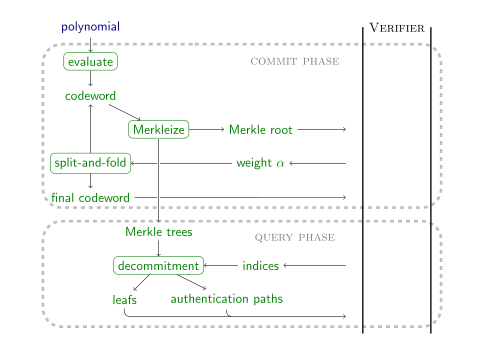
Image source: Anatomy of a STARK - FRI Protocol
The Polynomial Revolution
Interactive proofs and commitment schemes form the theoretical foundation, but the practical breakthrough came from an unexpected direction: polynomials.
A polynomial of degree $n$ is defined by $n+1$ coefficients. Yet a single polynomial equation $P(x) = Q(x)$ represents infinitely many numerical equations - it must hold at every point where both polynomials are defined. This property allows us to encode enormous computations into compact mathematical objects.
Consider proving that you know a number $x$ such that repeatedly hashing the string “cow” concatenated with $x$ one million times produces an output starting with specific digits. Naively, a verifier would need to perform one million hash operations to check your claim. But if you encode this computation as polynomial constraints, you can generate a proof that’s verified in milliseconds.
The key insight is that checking whether a polynomial satisfies certain properties at a random point is almost as good as checking everywhere. The Schwartz-Zippel lemma states that two different polynomials of degree $d$ agree on at most $d$ points. If you evaluate them at a random coordinate and they match, the probability that they’re different polynomials is vanishingly small.
Polynomial Commitment Schemes
A polynomial commitment scheme allows a prover to commit to a polynomial $P(x)$ and later prove evaluations like $P(3) = 42$ without revealing anything else about $P$. Three major schemes dominate modern implementations:
KZG Commitments use elliptic curve pairings to create commitments that are single group elements - typically just 32-48 bytes. The prover can open evaluations with proofs that are similarly compact. The trade-off is a trusted setup ceremony: a set of secrets must be generated and destroyed. If anyone retains these secrets, they can forge proofs.
FRI (Fast Reed-Solomon Interactive Oracle Proof) uses hash functions rather than elliptic curves, eliminating the trusted setup entirely. The prover commits to polynomial evaluations in a Merkle tree, then proves the polynomial’s low degree through repeated “folding” operations. Each fold reduces the degree by half until reaching a trivially verifiable constant. FRI forms the backbone of STARKs.
Bulletproofs use a different approach based on inner product arguments. They require no trusted setup and produce proofs that scale logarithmically with the statement size. However, verification is slower than KZG-based schemes.
SNARKs vs STARKs: The Architecture Decision
The two dominant zero-knowledge proof systems - SNARKs (Succinct Non-interactive ARguments of Knowledge) and STARKs (Scalable Transparent ARguments of Knowledge) - represent different engineering trade-offs.
ZK-SNARKs
Introduced in a 2012 paper by Nir Bitansky, Ran Canetti, Alessandro Chiesa, and Eran Tromer, SNARKs generate remarkably compact proofs - typically around 200-300 bytes. Verification is blazingly fast, often under 10 milliseconds on standard hardware. This efficiency makes them ideal for blockchain applications where every byte and every millisecond of verification counts.
The cost of this efficiency is the trusted setup. Before the system can be used, a ceremony must generate structured reference strings. During this ceremony, participants contribute randomness that’s incorporated into proving and verification keys. If all participants collude or are compromised, the underlying secrets could be recovered, allowing the creation of fraudulent proofs.
The cryptocurrency Zcash made SNARKs famous by using them to enable shielded transactions. Users can prove they have sufficient funds to spend without revealing their account balance, the source of funds, or the transaction amount. The Sapling upgrade in 2018 improved efficiency enough for mobile devices, demonstrating the practical maturity of the technology.
ZK-STARKs
Proposed by Eli Ben-Sasson, Iddo Bentov, Yinon Horesh, and Michael Riabzev in 2018, STARKs eliminate the trusted setup entirely. They rely solely on hash functions - cryptographic primitives so fundamental they’re considered “post-quantum” secure. If quantum computers ever threaten elliptic curve cryptography, STARKs will remain standing.
The transparency comes at a cost. STARK proofs are significantly larger - typically 45-150 kilobytes compared to SNARKs’ few hundred bytes. Verification is also slower, though still practical for most applications. However, STARKs scale better for complex computations. As the size of the statement grows, STARK proof generation time increases more slowly than SNARK generation time.
Performance Comparison
| Property | ZK-SNARK | ZK-STARK | Bulletproof |
|---|---|---|---|
| Proof Size | ~288 bytes | 45-150 KB | 1.5-3 KB |
| Verification Time | ~10 ms | ~50-100 ms | ~100-500 ms |
| Trusted Setup | Required | Not required | Not required |
| Quantum Resistant | No | Yes | Partially |
| Scalability | Good | Excellent | Moderate |
The proof size difference has significant implications for on-chain verification. A SNARK proof fits comfortably in a single blockchain transaction, while a STARK proof requires more gas to submit and verify. But for off-chain applications or layer-2 systems where proof size matters less, STARKs’ transparency can be decisive.
Beyond Blockchains: Practical Applications
The blockchain narrative dominates zero-knowledge discourse, but the technology’s applications extend far wider.
Identity and Authentication
Traditional password authentication requires transmitting the password (or a derivative) to a server. Even with hashing, the server learns enough to impersonate the user elsewhere. Zero-knowledge password proofs flip this model: the client proves knowledge of the password without ever transmitting it. The server stores only a commitment; a breach reveals nothing useful to attackers.
Private Credentials
Imagine proving you’re over 21 without revealing your exact age. Or demonstrating you have a valid university degree without disclosing which university or when you graduated. Zero-knowledge proofs enable selective disclosure - revealing only the minimal information necessary for verification. This transforms digital identity from an all-or-nothing proposition into a spectrum of privacy choices.
Voting Systems
Electronic voting faces a paradox: votes must be verifiable to ensure election integrity, but individual ballots must remain secret. Zero-knowledge proofs resolve this by allowing voters to prove their vote was counted without revealing how they voted. The system can prove that all votes came from eligible voters, that no votes were duplicated, and that the tally matches the cast ballots - all without exposing any individual’s choice.
Healthcare and Medical Records
Patients could prove they meet criteria for treatments, clinical trials, or insurance coverage without revealing their complete medical history. A diabetic could prove they qualify for specialized care without disclosing unrelated conditions. Research institutions could verify data integrity without accessing raw patient information.
The Security Landscape
Zero-knowledge proofs aren’t immune to vulnerabilities - they simply shift the attack surface.
Implementation Flaws
The theoretical security guarantees assume correct implementation. In practice, bugs in circuit design, incorrect constraint encoding, or mishandled randomness can compromise the entire system. A 2023 analysis of ZK-proof systems found vulnerabilities in how some libraries handle public inputs, potentially allowing malicious provers to generate proofs for false statements.
The Trusted Setup Problem
For SNARKs requiring trusted setup, the ceremony itself becomes a single point of failure. Early ceremonies used small groups of participants, creating genuine trust concerns. Modern ceremonies use multi-party computation with hundreds or thousands of participants, ensuring that even if all but one participant is malicious, the system remains secure. But the ceremony’s integrity must be independently auditable.
Quantum Considerations
Current SNARKs relying on elliptic curve pairings would be broken by sufficiently powerful quantum computers. STARKs using hash-based cryptography would survive. This doesn’t make SNARKs obsolete - quantum computers capable of breaking elliptic curves don’t yet exist, and migrating cryptographic systems is a gradual process. But for systems designed to last decades, quantum resistance becomes a design consideration.
Current Research Frontiers
The field evolves rapidly. Several research directions promise to reshape what’s possible.
Folding Schemes
Nova and other folding-based systems allow incremental proofs - proving one step of a computation, then folding in subsequent steps without re-proving everything. This enables proving arbitrarily long computations with constant verification time. A prover could demonstrate they correctly executed a billion-step program, yet verification would take the same time as proving a thousand-step program.
Zero-Knowledge Virtual Machines
Projects are building general-purpose virtual machines that generate zero-knowledge proofs for arbitrary programs. Instead of designing custom circuits for each application, developers write regular code, and the VM automatically generates proofs of correct execution. This dramatically lowers the barrier to adoption.
Recursive Proofs
A zero-knowledge proof can verify another zero-knowledge proof. This composability allows building complex systems from simpler components. A blockchain could aggregate thousands of individual proofs into a single succinct proof, maintaining verifiability while scaling throughput by orders of magnitude.
The Path Forward
Zero-knowledge proofs have journeyed from theoretical curiosity to production technology in four decades. What began as an answer to an academic question - “Can we prove without revealing?” - has become a fundamental tool for privacy, scalability, and trust in digital systems.
The technology isn’t a silver bullet. Implementations remain complex, verification costs aren’t negligible, and the trade-offs between proof size, setup requirements, and quantum resistance require careful consideration for each application. But the core promise holds: mathematics provides mechanisms for verification without revelation.
As digital systems become more pervasive and data breaches more costly, the value of proving without revealing only grows. Zero-knowledge proofs offer a path toward systems that verify what matters while protecting what doesn’t - a balance that the information age desperately needs.
References
-
Goldwasser, S., Micali, S., & Rackoff, C. (1985). The Knowledge Complexity of Interactive Proof Systems. SIAM Journal on Computing.
-
Ben-Sasson, E., et al. (2018). Scalable, transparent, and post-quantum secure computational integrity. IACR Cryptology ePrint Archive.
-
Bitansky, N., et al. (2012). From Extractable Collision Resistance to Succinct Non-Interactive Arguments of Knowledge, and Back Again. ITCS 2012.
-
Ben-Sasson, E., et al. (2019). Anatomy of a STARK. Technical documentation.
-
Buterin, V. (2021). An approximate introduction to how zk-SNARKs are possible. vitalik.eth.limo.
-
Gabizon, A., et al. (2019). PLONK: Permutations over Lagrange-bases for Oecumenical Noninteractive arguments of Knowledge. IACR Cryptology ePrint Archive.
-
Bünz, B., et al. (2018). Bulletproofs: Short Proofs for Confidential Transactions and More. IEEE S&P 2018.
-
Wahby, R. S., & Boneh, D. (2023). 17 misconceptions about SNARKs (and why they hold us back). a16z crypto.
-
Zhang, Y., et al. (2023). Zero Knowledge Proofs MOOC. Educational materials.
-
Maller, M., et al. (2019). Sonic: Zero-Knowledge SNARKs from Linear-Size Universal and Updatable Structured Reference Strings. ACM CCS 2019.