On July 20, 1976, Bryce Bayer received U.S. Patent No. 3,971,065 for a “Color imaging array.” The Kodak engineer had no way of knowing that his checkerboard pattern of red, green, and blue filters would become the foundation for virtually every color digital photograph taken since. But the Bayer filter was just one piece of a much larger puzzle: how do we transform particles of light into the millions of colored dots that make up a digital image?
The journey from photon to pixel involves quantum physics, silicon chemistry, sophisticated algorithms, and increasingly complex sensor architectures. Each step in this chain represents decades of engineering evolution, with trade-offs that continue to shape the cameras in our pockets today.
The Photon Catcher: Silicon Photodiodes
At the heart of every camera sensor lies a deceptively simple device: the photodiode. When a photon strikes a silicon atom within this semiconductor, it can liberate an electron from its atomic bond, creating an electron-hole pair. This is the internal photoelectric effect, and it’s the fundamental mechanism that converts light into electricity.
The probability that any given photon will generate an electron is called quantum efficiency (QE). In modern sensors, peak QE can exceed 80%, meaning four out of five photons at optimal wavelengths successfully create a detectable electron. But this efficiency varies dramatically with wavelength. Silicon’s bandgap energy is approximately 1.12 electron volts, which corresponds to photons with wavelengths up to about 1,100 nanometers. Shorter wavelengths—blue and ultraviolet light—carry more energy and are absorbed near the silicon surface, often within tens of nanometers. Red and near-infrared photons penetrate deeper, sometimes traveling micrometers before being absorbed.
This wavelength-dependent absorption depth explains why modern sensors have thickness specifications that matter. A sensor that’s too thin will let red light pass through unabsorbed, reducing sensitivity at longer wavelengths. The careful engineering of epitaxial silicon layers—typically 3 to 10 micrometers thick—balances sensitivity across the visible spectrum.
The Color Problem: Why Green Gets Twice the Real Estate
Silicon photodiodes are inherently monochromatic. They count electrons, not wavelengths. To capture color, sensor designers had to add filters that selectively pass certain wavelengths while blocking others. The solution Bayer patented arranges these filters in a 2×2 repeating pattern: one red, one blue, and two green filters.
The predominance of green isn’t arbitrary. Human vision is most sensitive to green wavelengths, which correspond to the combined response of our medium-wavelength (M) and long-wavelength (L) cone cells under daylight conditions. Bayer explicitly called his green photosensors “luminance-sensitive elements” and the red and blue ones “chrominance-sensitive elements”—terminology borrowed from color television engineering of the era.
The color filters themselves are typically dyed photoresist materials, patterned directly onto the silicon surface using photolithographic processes similar to those used for making integrated circuits. Each filter allows only a narrow band of wavelengths to pass—roughly 100-150 nanometers wide—blocking everything else. This selectivity comes at a cost: roughly two-thirds of the light never reaches the silicon, having been absorbed by the “wrong” color filter.

Image source: Wikipedia
Demosaicing: The Algorithmic Reconstruction
The raw output from a Bayer sensor doesn’t look like a photograph. It’s a mosaic where each pixel records only one color value. A pixel under a green filter has no direct information about red or blue at that location. Reconstructing the full-color image requires interpolation—a process called demosaicing or debayering.
The simplest approach, bilinear interpolation, averages neighboring pixels of the same color to estimate missing values. For a green pixel, the red value might be computed as the average of the two nearest red neighbors, and similarly for blue. This works adequately in smooth regions but fails catastrophically at edges, where it produces color bleeding and zipper artifacts.
More sophisticated algorithms exploit spatial correlations. Gradient-corrected interpolation examines local texture direction and interpolates along edges rather than across them. The underlying assumption is that color ratios tend to be constant within localized regions—where luminance changes abruptly, chrominance often remains stable.
Modern demosaicing has evolved into a computationally intensive process that can include edge detection, pattern recognition, and even machine learning approaches. Some raw processing software applies dozens of correction passes to minimize artifacts while preserving detail.
CCD vs. CMOS: The Architecture Wars
For the first three decades of digital imaging, two fundamentally different sensor architectures competed for dominance. Charge-Coupled Devices (CCDs) move accumulated charge packets across the sensor surface like a bucket brigade, transferring electrons from pixel to pixel until they reach a single output amplifier. This serial readout produces very clean signals with low noise, but it’s inherently slow and power-hungry.
CMOS sensors take a different approach. Each pixel contains its own amplifier and readout circuitry, allowing parallel access to all pixels simultaneously. Early CMOS sensors suffered from higher noise due to manufacturing variations between individual pixel amplifiers—a problem called fixed-pattern noise. But the parallel architecture enables much faster readout speeds and dramatically lower power consumption.
By the early 2010s, advances in semiconductor manufacturing had reduced CMOS noise to competitive levels, and the technology’s inherent advantages in speed, power, and integration won out. Today, CCD sensors are largely confined to specialized scientific applications where their unique characteristics—particularly the absence of rolling shutter artifacts—remain valuable.
Back-Side Illumination: Flipping the Sensor
In a traditional front-side illuminated (FSI) sensor, light must pass through layers of metal wiring and transistors before reaching the photosensitive silicon. This circuitry can block 30-50% of the incoming light, creating a problem called low fill factor. Microlenses placed above each pixel help focus light through the gaps, but they add complexity and cost.
Back-side illumination (BSI) solves this by thinning the silicon wafer and flipping it over, so light enters from the back side, unobstructed by circuitry. The result is a dramatic improvement in light-gathering efficiency—often described as roughly one f-stop advantage in low-light performance.
Manufacturing BSI sensors requires precise wafer thinning to just a few micrometers thickness, then bonding the thinned sensor layer to a support substrate. The process is more expensive but has become standard for high-end smartphone cameras and professional equipment.
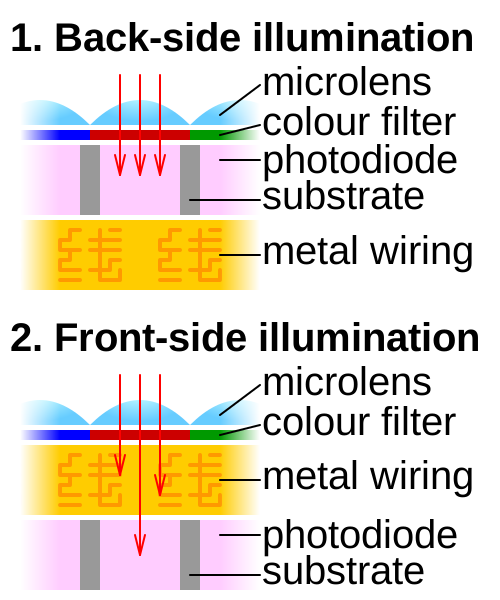
Image source: Wikipedia
Stacked Sensors: The Three-Dimensional Future
The latest evolution in sensor architecture moves beyond planar designs. Stacked CMOS sensors separate the photosensitive layer from the processing circuitry, placing them on different silicon dies bonded together. This separation allows the pixel layer to be optimized purely for light collection, while the logic layer can incorporate sophisticated processing capabilities.
A three-layer stacked sensor might include the photodiode array on top, a DRAM layer in the middle for high-speed temporary storage, and a logic layer at the bottom containing analog-to-digital converters and image processing circuits. This architecture enables readout speeds previously impossible—up to 1,000 frames per second at full HD resolution in some implementations.
The performance benefits extend beyond speed. With processing circuitry located directly beneath each pixel column, signals can be digitized immediately, reducing noise and improving dynamic range. The proximity also reduces power consumption and enables on-sensor computational photography features.
The Noise Budget: Counting Photons in the Dark
Every camera image is contaminated by noise from multiple sources, each with distinct characteristics. Shot noise arises from the quantum nature of light itself—photon arrivals follow Poisson statistics, so even a perfectly uniform light source produces random fluctuations in the number of photons captured. For $N$ photons, the shot noise is $\sqrt{N}$, meaning the signal-to-noise ratio improves as $\sqrt{N}$. Bright scenes naturally have better SNR because more photons provide more statistical certainty.
Read noise is added by the sensor’s electronic readout circuitry. Modern CMOS sensors have pushed read noise below one electron in some designs, but this required decades of engineering refinement. Earlier generations struggled with read noise of 10-20 electrons, limiting low-light performance.
Dark current represents thermally generated electrons that accumulate even without illumination. This noise source doubles approximately every 5-7°C, which is why astrophotographers cool their sensors and why smartphone cameras struggle with long exposures in warm conditions. Dark current also exhibits spatial non-uniformity—different pixels accumulate thermal electrons at slightly different rates, creating a fixed pattern that must be subtracted through calibration.
Pixel Response Non-Uniformity (PRNU) describes variation in sensitivity between pixels due to manufacturing differences. Like dark current non-uniformity, it’s a spatially fixed pattern that can be characterized and corrected, but never eliminated.
Beyond Bayer: Alternative Color Capture Strategies
The Bayer filter’s dominance hasn’t stopped engineers from exploring alternatives. Fujifilm’s X-Trans sensor uses a 6×6 repeating pattern with a more randomized distribution of red, green, and blue filters. This arrangement reduces moiré patterns without requiring an optical low-pass filter, potentially improving resolution.
The Foveon X3 sensor takes a fundamentally different approach, using silicon’s wavelength-dependent absorption depth as a natural color separator. Three stacked photodiodes capture different colors at different depths—blue near the surface, green in the middle, and red deepest. This eliminates demosaicing entirely, providing true per-pixel RGB capture. However, the technology has struggled with noise and sensitivity compared to Bayer-based designs.
Quad Bayer and similar pixel-binning approaches group four adjacent pixels of the same color, allowing them to function as one large pixel in low light or as four separate pixels in bright conditions. This hybrid approach has become common in smartphone cameras with high megapixel counts.
References
- Bayer, B.E. (1976). “Color imaging array.” U.S. Patent No. 3,971,065.
- Nakamura, J. (2005). “Image Sensors and Signal Processing for Digital Still Cameras.” CRC Press.
- Theuwissen, A.J.P. (1995). “Solid-State Imaging with Charge-Coupled Devices.” Kluwer Academic Publishers.
- Fossum, E.R. (1997). “CMOS image sensors: Electronic camera-on-a-chip.” IEEE Transactions on Electron Devices.
- Seitz, P. (2011). “Smart pixel sensors.” in “Single-Photon Imaging,” Springer.
- Lyon, R.F. & Hubel, P.M. (2002). “Eyeing the Camera: into the Next Century.” IS&T/OSA Symposium.
- Haruta, T. et al. (2017). “A 1/2.3inch 20Mpixel 3-layer stacked CMOS Image Sensor with DRAM.” ISSCC.
- Dickson, C. et al. (2020). “Color conversion matrices in digital cameras: a tutorial.” Optical Engineering.