On January 23, 1997, at approximately 2 AM in a windowless basement laboratory at MIT, two undergraduate students achieved something that experts had declared impossible. Barrett Comiskey and JD Albert placed a microcapsule between two copper electrodes, slid it under a microscope, and watched as an external electric field moved particles inside the capsule for the first time. They had just proven that electronic ink could work.
The technology they developed that night would eventually power millions of e-readers, electronic shelf labels, and digital signage displays worldwide. But what makes e-ink fundamentally different from every other display technology? The answer lies in the physics of moving actual particles through fluid—a mechanism so elegantly simple that it took a decade for commercialization to catch up with the concept.
The Microcapsule Architecture
At the heart of every e-ink display lies a deceptively simple structure: millions of microcapsules, each approximately 100 micrometers in diameter—roughly the width of a human hair. Inside each microcapsule floats a clear dielectric fluid containing two types of charged particles. Negatively charged black particles, typically made of carbon black, and positively charged white particles, composed of titanium dioxide pigment—the same material used to make white paint and paper appear bright.
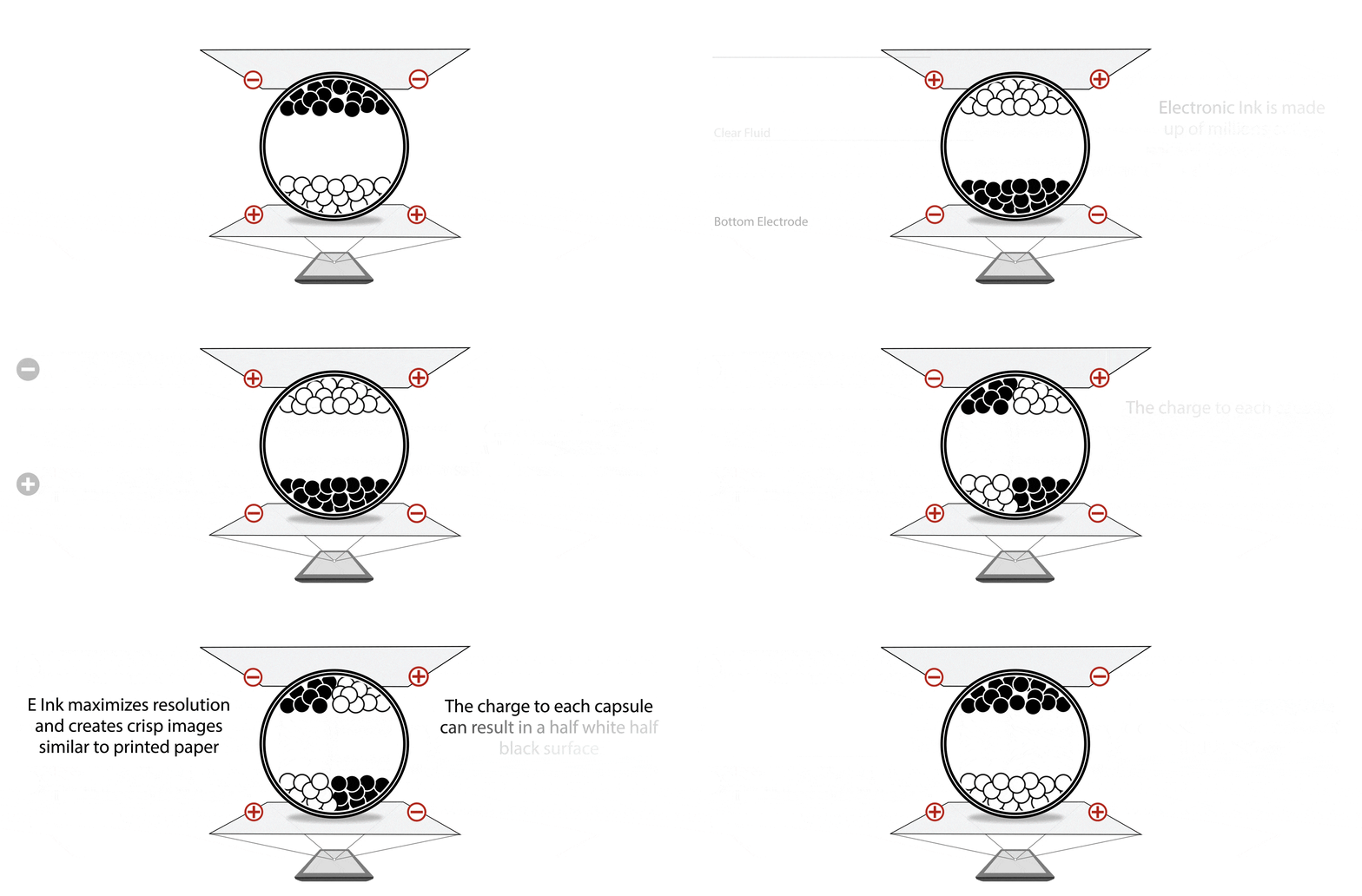
Image source: E Ink Corporation
This arrangement creates a bistable system. When a positive electric field is applied to the top electrode, the negatively charged black particles are attracted upward, making that spot appear dark. Reverse the field, and the positively charged white particles rise to the surface, creating a white appearance. The particles remain in position even after power is removed because there’s no force acting on them—the image is physically “locked” in place until the next refresh cycle.
Why E-Ink Consumes Virtually No Power
The bistability of e-ink explains why e-readers can last weeks on a single charge while smartphones barely survive a day. An LCD display requires continuous power to maintain its backlight and refresh the liquid crystals 60 times per second. An OLED screen emits light through constant electrical stimulation of organic compounds. E-ink does neither.
Once the particles have moved to their positions, they stay there. Power is only consumed during the brief moments when the image changes—typically less than half a second per page turn on modern displays. A typical e-reader with 30 minutes of daily reading might change pages 300 times, each refresh consuming milliwatts for roughly 300 milliseconds. The math works out to a few seconds of actual power consumption per day, which is why manufacturers can honestly claim “weeks of battery life.”

Image source: Orient Display
The Refresh Rate Problem: Physics, Not Engineering
If e-ink is so elegant, why does it flash and flicker during page turns? Why can’t it display smooth video like an LCD or OLED? The answer reveals the fundamental trade-off at the core of electrophoretic technology.
E-ink forms images by physically moving micron-sized particles through a viscous dielectric fluid. Unlike electrons traveling through a conductor at near-light speeds, these particles must literally swim through liquid. The velocity of electrophoretic particle movement follows Stokes’ Law for drag on spherical particles:
$$v = \frac{qE}{6\pi\eta r}$$Where $v$ is velocity, $q$ is particle charge, $E$ is the electric field strength, $\eta$ is fluid viscosity, and $r$ is particle radius. The viscosity term is critical—these fluids are intentionally viscous to prevent random particle drift and maintain image stability. But that same viscosity creates significant resistance to movement.
A full refresh on an e-ink display takes between 100 milliseconds and several seconds, depending on the mode and complexity. The flashing you see during a page turn isn’t a flaw—it’s a deliberate sequence of clearing the screen, driving particles to reference positions, and then settling them into the new image. Skipping this process causes “ghosting,” where faint remnants of previous images remain visible.
sequenceDiagram
    participant User
    participant Controller
    participant Display
    Note over Display: Current image displayed (no power needed)
    User->>Controller: Request page turn
    Controller->>Display: Apply clearing voltage
    Note over Display: Particles reset to reference state
    Controller->>Display: Apply image voltage waveform
    Note over Display: Particles move to new positions
    Controller->>Display: Remove power
    Note over Display: New image locked in place (no power needed)
Temperature compounds the problem. At lower temperatures, the dielectric fluid becomes more viscous, slowing particle movement even further. This is why e-readers often feel sluggish in cold environments and why manufacturers specify operating temperature ranges.
The Long Road to Color
Creating color e-ink proved far more challenging than the original black-and-white technology. The first approach, introduced in 2010 as E Ink Triton, used a color filter array placed above the standard black-and-white ink layer. Red, green, and blue filters would selectively tint the reflected white light, producing color images.
The problem? Color filters absorb most of the incoming light. A monochrome e-ink display reflects roughly 40-45% of ambient light—comparable to newspaper print. Adding a color filter layer dropped reflectivity to around 13%, making colors appear muted and washed out. Additionally, splitting each pixel into three sub-pixels reduced resolution by a factor of three.
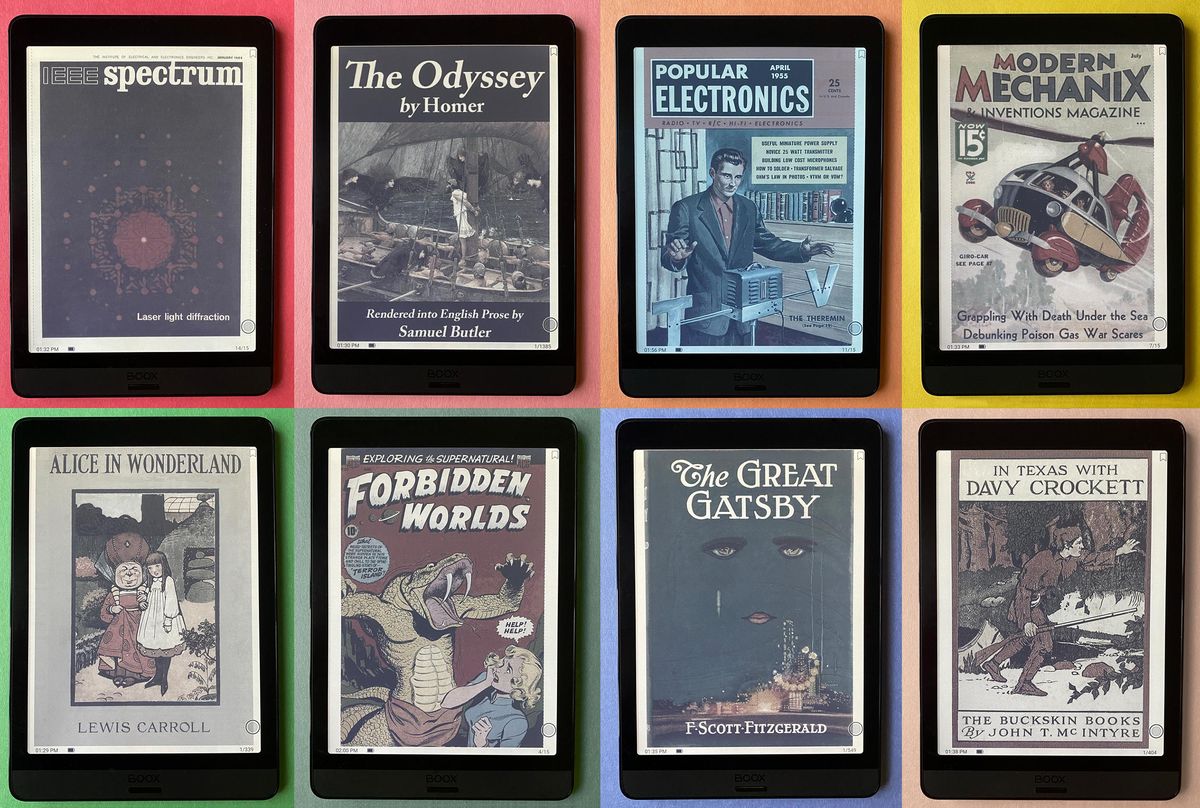
Image source: IEEE Spectrum
The second generation, called Kaleido, improved brightness by printing the color filters directly onto the plastic film containing the top electrode, bringing them closer to the ink layer. But the fundamental limitations remained: filtered color will never match the brightness of direct pigment.
True full-color e-ink requires a fundamentally different approach. E Ink’s Advanced Color ePaper (ACeP), launched in 2016, uses four types of pigment particles in each microcapsule: cyan, magenta, yellow, and white. By precisely controlling the vertical position of each particle type using carefully designed voltage waveforms, the system can produce up to 50,000 distinct colors.

Image source: Orient Display
The complexity, however, is enormous. Controlling four particle types requires sophisticated waveforms that can take several seconds to execute—acceptable for static signage but impractical for interactive devices. This is why most color e-readers still use the faster-but-dimmer Kaleido technology.
Beyond E-Readers: The Unexpected Applications
The same properties that make e-ink ideal for reading—low power consumption, sunlight readability, and image persistence—have found applications far beyond consumer electronics. Electronic shelf labels in retail stores can display prices for years on a single battery, updating wirelessly when needed. Bus stop signs can remain readable in direct sunlight while consuming minimal energy from solar panels. Smart cards with e-ink displays can show one-time passwords or account balances without embedded batteries.
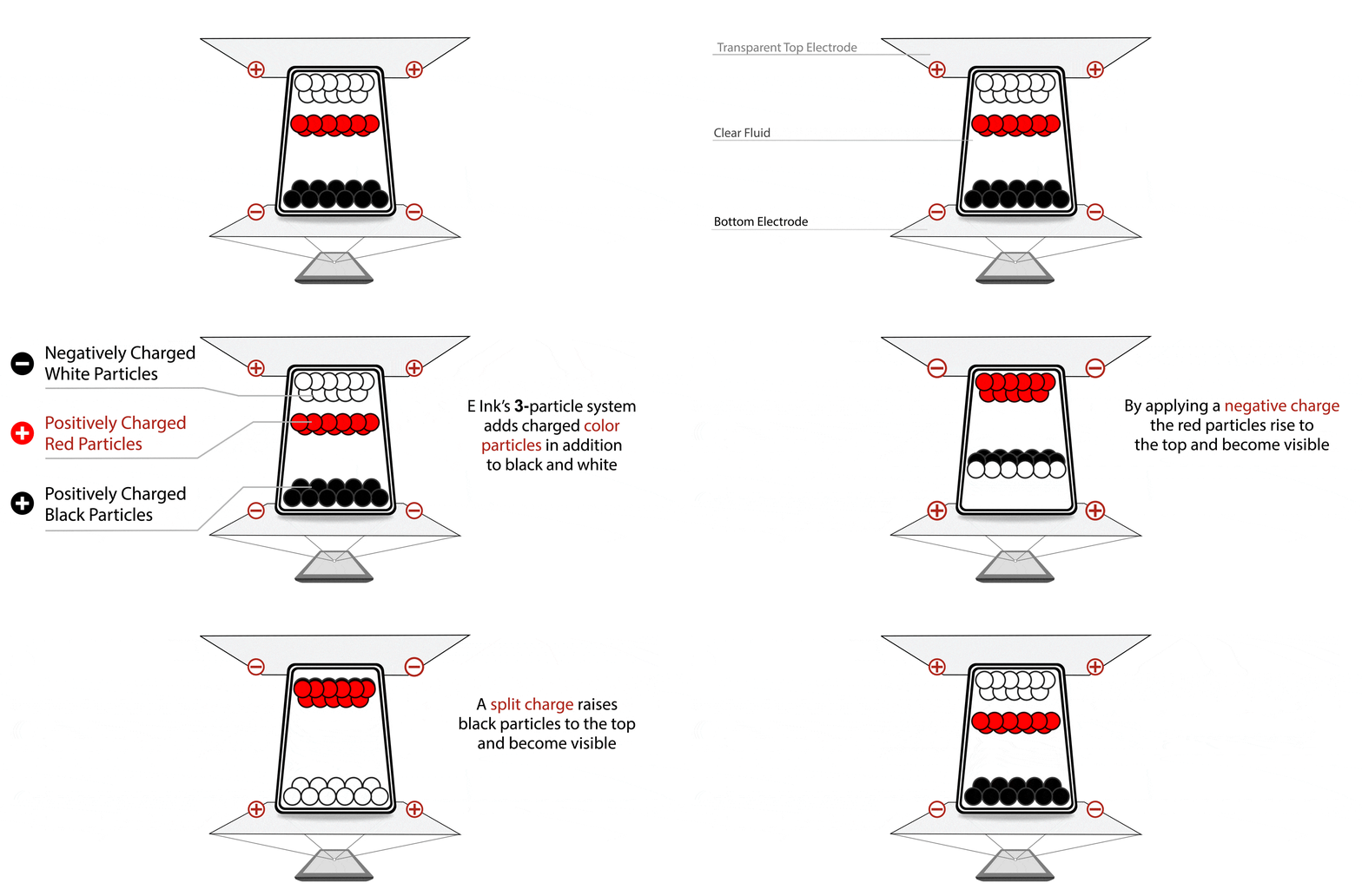
Image source: E Ink Corporation
The architecture industry has adopted e-ink for dynamic building facades that can change appearance without the energy costs of traditional displays. Automotive companies have experimented with e-ink panels for customizable vehicle exteriors. The technology’s ability to maintain an image without power makes it uniquely suited for applications where energy efficiency matters more than refresh speed.
The Engineering Trade-offs
| Property | E-Ink | LCD | OLED |
|---|---|---|---|
| Light source | Reflective | Transmissive (backlight) | Emissive |
| Power consumption | Near zero (static) | Continuous | Continuous |
| Sunlight readability | Excellent | Poor | Poor |
| Refresh rate | 100ms - seconds | 1-16ms | <1ms |
| Contrast ratio | ~15:1 | 1000:1+ | Infinite |
| Viewing angle | 180° | 170° | 180° |
E-ink occupies a unique position in the display landscape. It cannot compete with LCDs or OLEDs in color vibrancy, refresh speed, or dark-room contrast. But for applications requiring long battery life, outdoor visibility, or eye comfort during extended reading, no other technology comes close.
The Future of Electronic Paper
Research continues on improving e-ink’s weak points. New driving algorithms reduce refresh times while maintaining image quality. Different fluid formulations lower viscosity without sacrificing bistability. Alternative particle chemistries promise faster response and better color saturation.
The fundamental physics, however, remains unchanged: moving physical particles through fluid will always be slower than modulating light through liquid crystals or exciting organic emitters. E-ink’s future lies not in matching conventional displays across all metrics, but in embracing its unique strengths. As battery life becomes increasingly critical for sustainable technology, the ability to display information with near-zero power consumption may prove more valuable than ever.
Twenty-eight years after that basement breakthrough, the technology that experts said was impossible has become ubiquitous. The students who danced at 2 AM in an MIT laboratory created something genuinely new—a display that works not by fighting against ambient light, but by harnessing it. In a world of glowing screens, e-ink remains quietly, stubbornly different.
References
-
Comiskey, B., Albert, J.D., Yoshizawa, H., and Jacobson, J. (1998). An electrophoretic ink for all-printed reflective electronic displays. Nature, 394, 253-255.
-
Huitema, E., and French, I. (2022). How E Ink developed full-color e-paper. IEEE Spectrum.
-
E Ink Corporation. (2025). Electronic Ink Technology. Retrieved from https://www.eink.com/tech/detail/How_it_works
-
Orient Display. (2026). Why Does E ink Refresh Slowly? Retrieved from https://www.orientdisplay.com/why-does-e-ink-refresh-slowly/
-
Science Friday. (2016). How Electronic Ink Was Invented. Retrieved from https://www.sciencefriday.com/articles/how-electronic-ink-was-invented/
-
MIT Media Lab. (2022). How E Ink developed full-color e-paper. Retrieved from https://www.media.mit.edu/articles/how-e-ink-developed-full-color-e-paper/
-
MDPI Sensors. (2018). Improving Electrophoretic Particle Motion Control in Electrophoretic Displays. Micromachines, 9(4), 143.