When Google released Chrome in 2008, its JavaScript performance was revolutionary. The secret was V8, an engine that compiled JavaScript directly to machine code rather than interpreting it. But the V8 of 2026 bears almost no resemblance to that original design. Four compilation tiers, speculative optimization based on runtime feedback, and a constant battle between compilation speed and execution speed have transformed JavaScript from a “slow scripting language” into something that routinely outperforms carefully optimized C++ for many workloads.
Understanding how V8 actually executes your code isn’t just academic curiosity. The difference between monomorphic and megamorphic inline caches can mean a 100x performance gap. A single deoptimization event can invalidate millions of cycles of optimization work. And the assumptions you make about object shapes determine whether the optimizing compiler generates tight assembly or falls back to generic runtime calls.
The Four-Tier Pipeline: Why JavaScript Needs Multiple Compilers
Modern V8 uses four distinct execution tiers, each making different trade-offs between compilation time and execution speed. This isn’t complexity for its own sake—it’s a direct response to the fundamental tension in JavaScript performance.
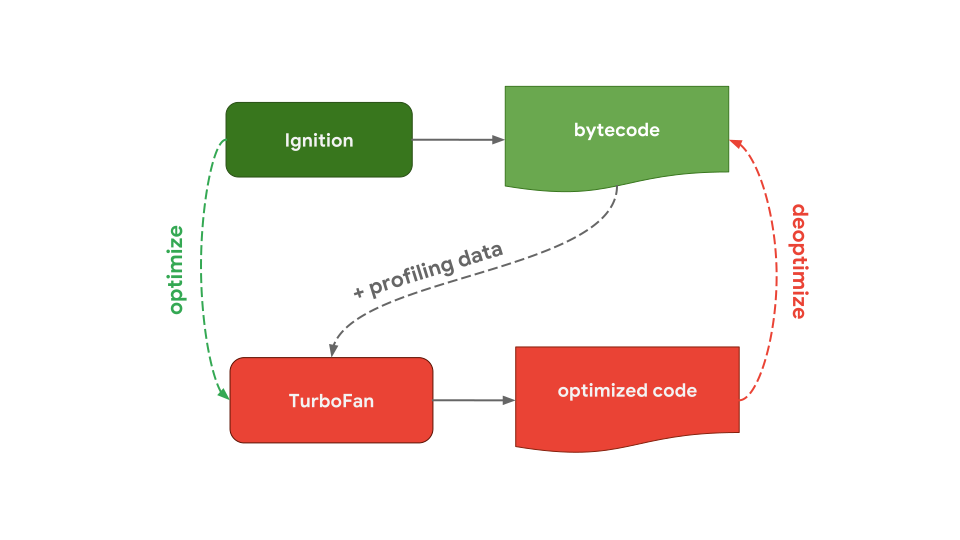
Image source: Mathias Bynens - JavaScript engine fundamentals
JavaScript has no static types. A function that receives {x: 1} once might receive {x: "hello"} the next call. Properties can be added, deleted, or converted to accessors at any time. Prototype chains can be modified. This dynamism makes ahead-of-time compilation nearly impossible—you simply cannot generate optimal machine code without knowing what your inputs actually look like.
The Ignition interpreter handles this dynamism natively. It converts your JavaScript into bytecode, a compact intermediate representation that V8 can execute directly. Ignition doesn’t try to be fast—it tries to start quickly. There’s no compilation delay, no warmup period. Your code starts running immediately.
But interpretation has limits. Each bytecode operation involves a dispatch loop, type checks, and generic handling for all possible cases. For code that runs once or twice, this overhead is negligible. For hot loops executing millions of iterations, it becomes a bottleneck.
Sparkplug, introduced in 2021, is the baseline JIT compiler. It performs a straightforward translation of Ignition bytecode into machine code—almost one-to-one, with minimal optimization. The compilation is nearly instantaneous, but the resulting code runs roughly 4-8x faster than interpretation because it eliminates the interpreter dispatch overhead.
Maglev, shipped in Chrome 117 (2023), occupies the middle ground. It builds a proper intermediate representation, performs type specialization based on collected feedback, and generates significantly better code than Sparkplug. But it compiles 10x faster than TurboFan, making it viable for functions that are hot but not hot enough to justify full optimization.
TurboFan is the optimizing compiler. It performs aggressive inlining, loop optimizations, escape analysis, and generates highly specialized machine code. But optimization is expensive—a complex function might take hundreds of milliseconds to compile. TurboFan only activates for genuinely hot code after extensive feedback collection.
Hidden Classes: Giving Dynamic Objects Static Shape
Every JavaScript object in V8 has an associated hidden class (called a “Map” internally, confusingly). These hidden classes are V8’s way of imposing structure on JavaScript’s chaotic object model.
According to the ECMAScript specification, objects are dictionaries mapping property names to property attributes. A naive implementation would store each object as a hash table. But hash table lookups are slow—$O(n)$ in the worst case, and even $O(1)$ average case involves hashing and collision resolution.
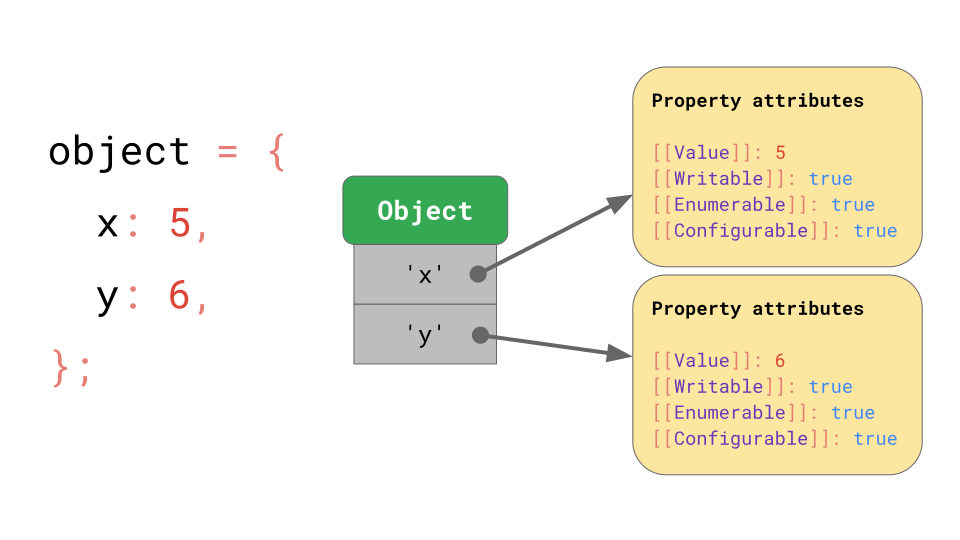
Image source: Mathias Bynens - JavaScript engine fundamentals
Consider two objects:
const object1 = { x: 1, y: 2 };
const object2 = { x: 3, y: 4 };
Both have the same shape: properties x and y added in that order. V8 recognizes this and gives them the same hidden class. The hidden class stores metadata about the properties—where they’re located in memory, their attributes, their types. The objects themselves store only the actual values.
The memory savings are substantial. With a million objects of the same shape, you store the property metadata once, not a million times. But the real benefit emerges during property access.
When you write object.x, V8 doesn’t need to hash “x” and search a dictionary. The hidden class tells it exactly where x lives—perhaps at offset 12 bytes from the object’s start. Property access becomes a simple memory load at a fixed offset.
Transition Chains: How Hidden Classes Evolve
Hidden classes aren’t static. When you add a property to an object, its hidden class changes. V8 maintains transition chains to track these relationships:
const point = {};
point.x = 1;  // Transition from empty shape to shape with x
point.y = 2;  // Transition to shape with x and y
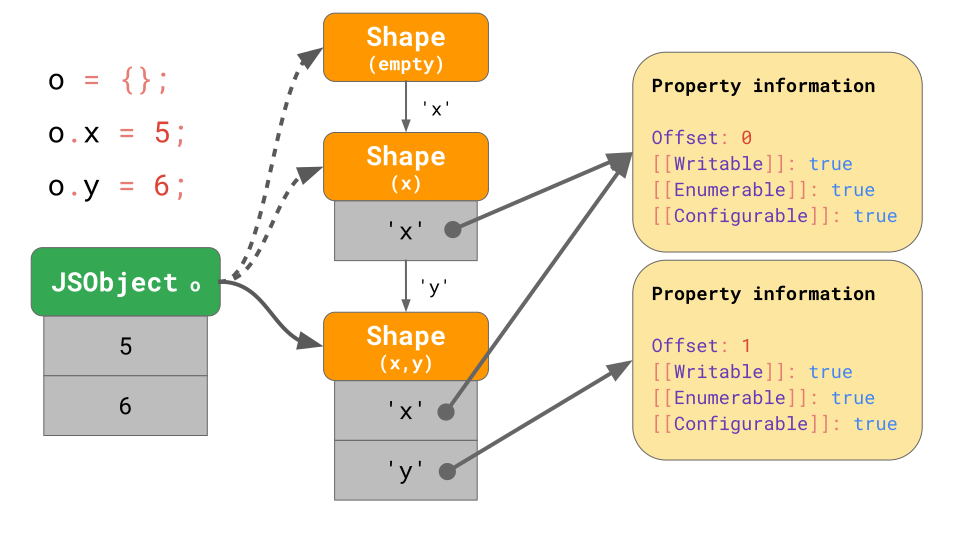
Image source: Mathias Bynens - JavaScript engine fundamentals
Each hidden class knows which property it introduces and links back to its predecessor. When V8 encounters a property access on a new object, it walks the transition chain to find the property’s offset. This is still $O(n)$ in the number of properties, but n is typically small, and V8 caches these lookups.
The critical insight: property order matters. {x: 1, y: 2} and {y: 2, x: 1} have different hidden classes. This has real performance implications. If you create objects from the same constructor in different ways, you fragment your hidden classes, losing the benefits of monomorphism.
Inline Caches: The Performance Secret
Hidden classes enable optimization, but inline caches (ICs) exploit it. An inline cache is exactly what it sounds like—a cache embedded directly in the generated code at each property access site.
Consider this function:
function getX(o) {
  return o.x;
}
The first time getX executes with {x: 1}, V8 must perform a full property lookup. But it also records what it discovered: this object had hidden class H, and property x was at offset 12. This information goes into the inline cache attached to the o.x bytecode.
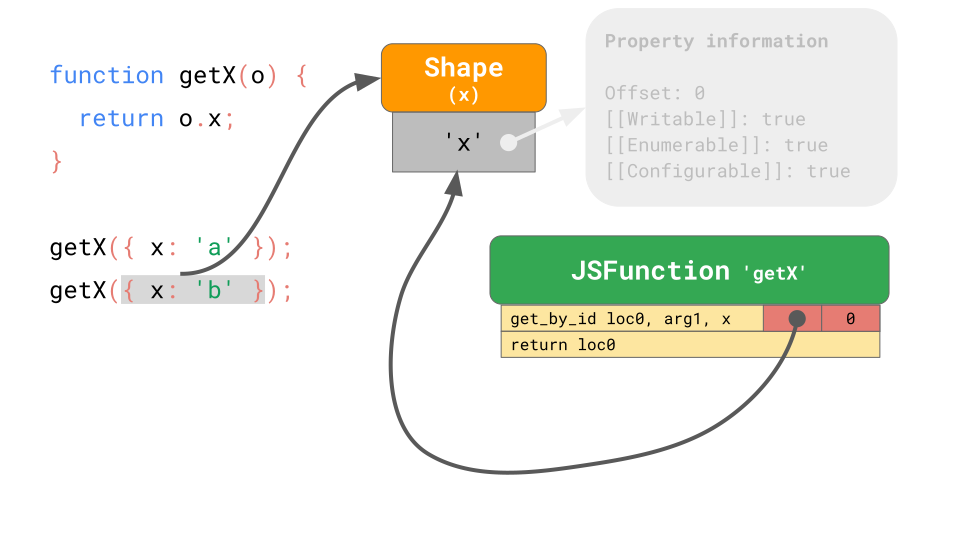
Image source: Mathias Bynens - JavaScript engine fundamentals
Subsequent calls check the object’s hidden class against the cached class. If they match, V8 loads directly from offset 12—no lookup needed. The property access becomes as fast as a C struct field access.
Monomorphic, Polymorphic, Megamorphic
The IC state dramatically affects performance:
Monomorphic (one shape seen): The ideal state. A single hidden class check, then direct access. Fastest possible property access.
Polymorphic (2-4 shapes seen): V8 stores multiple hidden class/offset pairs. Each access performs a linear search through these entries. Still fast, but with overhead that grows with the degree of polymorphism.
Megamorphic (many shapes seen): The IC gives up on local caching and falls back to a global hash table. This is much slower—each property access involves hash computation and table lookup.
function process(item) {
  return item.value;  // IC state depends on what shapes are seen
}

// Monomorphic case
process({value: 1});
process({value: 2});

// Now polymorphic
process({value: 3, extra: true});

// Megamorphic threshold
process({value: 4, a: 1});
process({value: 5, b: 2});
process({value: 6, c: 3});
The performance cliff is real. Vyacheslav Egorov’s research shows monomorphic access can be 4-100x faster than megamorphic for the same operation. This isn’t premature optimization—it’s understanding how your tools actually work.
Speculative Optimization and Deoptimization
Inline caches serve a dual purpose: they speed up unoptimized execution, and they collect type feedback for the optimizing compiler. This feedback drives speculative optimization.
When TurboFan compiles a function, it examines the ICs to understand what types have been seen. If o.x has only ever seen objects with hidden class H, TurboFan generates specialized code that assumes H. It inserts a type guard that checks o’s hidden class and, if the check fails, triggers deoptimization.
Deoptimization is the process of discarding optimized code and resuming execution in the interpreter. It’s expensive—you lose all the optimization work, and you pay the cost of reconstructing interpreter state. But it’s necessary because JavaScript’s dynamism means assumptions can always be violated.
function add(a, b) {
  return a + b;
}

// Called with numbers 1000 times
// TurboFan speculates: "a and b are always Smis (small integers)"
// Generates specialized integer addition with overflow check

// Suddenly called with strings
add("hello", "world");
// Deoptimization triggered! Overflow check fails, deopt to interpreter
The optimizing compiler walks a tightrope. Generate too specialized code, and you risk frequent deoptimization. Generate too generic code, and you leave performance on the table. V8’s solution is tiered compilation: start conservative, collect more feedback, re-optimize with better information.
The Feedback Vector
Ignition maintains a feedback vector for each function—a data structure that captures runtime behavior. Every property access, arithmetic operation, and function call records what types it encountered. This isn’t just for inline caches; it’s the raw material for optimization.
When TurboFan compiles a function, it reads the feedback vector to understand the function’s “shape.” Has this addition only seen integers? Has this property access only seen one hidden class? Has this function call always targeted the same function (enabling inlining)?
The feedback vector is why V8 performs better on realistic workloads than synthetic benchmarks. Real code exhibits stable patterns—objects created from the same constructor tend to have the same shape, arithmetic operations tend to see consistent types. The optimizing compiler exploits this stability.
Sea of Nodes: The IR That Almost Broke V8
TurboFan’s intermediate representation deserves special attention. From 2013 to 2023, TurboFan used “Sea of Nodes”—a radical departure from traditional compiler IR.
In a traditional control-flow graph (CFG), code is organized into basic blocks—sequences of instructions with no internal branching. Operations are implicitly ordered within blocks.
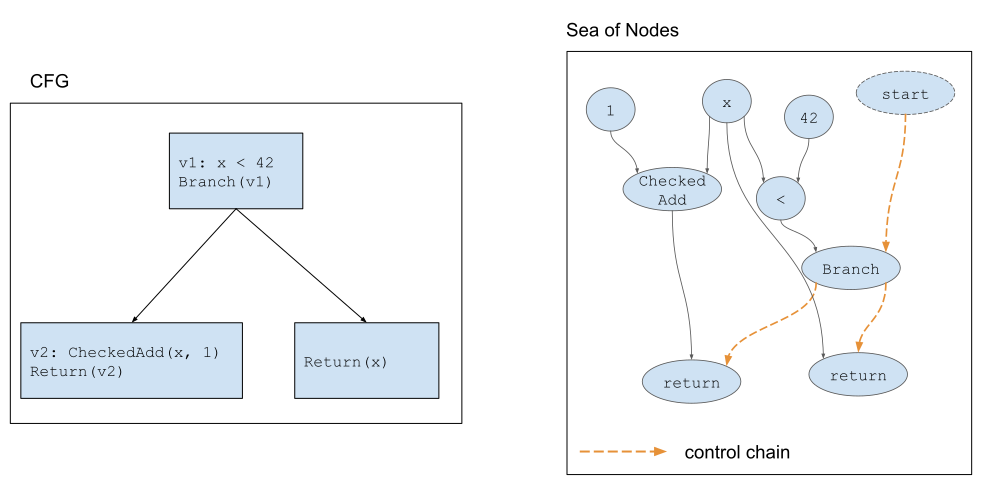
Image source: V8 Blog - Leaving the Sea of Nodes
Sea of Nodes represents each operation as an individual node with explicit dependencies. Value edges connect nodes that produce and consume values. Control edges impose ordering on operations that need it (branches, returns). Effect edges order memory operations (loads, stores).
The theory was elegant: pure operations without dependencies could “float” freely in the graph, allowing the scheduler to place them optimally. x * 2 used only in one branch could float into that branch, avoiding unnecessary computation.
The reality was painful. JavaScript’s pervasive side effects meant most operations needed control and effect edges. Property access might invoke a getter. Arithmetic might call valueOf(). Nearly every operation had dependencies, defeating the “floating nodes” advantage.
More critically, Sea of Nodes was hard to debug. A graph with thousands of interconnected nodes, each with value, control, and effect edges, resembles a bowl of spaghetti. Compiler engineers struggled to understand optimization passes, track bugs, and reason about transformations.
In 2023, V8 began migrating to Turboshaft—a traditional CFG-based IR. The results were dramatic: better cache locality, simpler optimization passes, faster compilation. Load elimination became 190x faster with Turboshaft than with Sea of Nodes.
Maglev: The Fast Optimizing Compiler
The gap between Sparkplug and TurboFan was too large. Code that was hot enough to benefit from optimization but not hot enough to justify TurboFan’s compile time languished in Sparkplug’s unoptimized output.
Maglev fills this gap. It’s an SSA-based optimizing compiler that generates good code quickly—about 10x slower to compile than Sparkplug, but 10x faster than TurboFan.
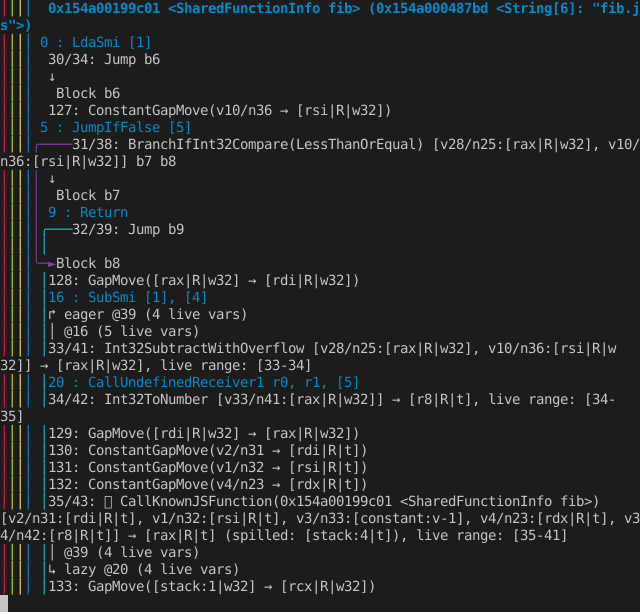
Image source: V8 Blog - Maglev: V8’s Fastest Optimizing JIT
Maglev’s design philosophy is “good enough, fast enough.” It performs type specialization using feedback, inlines small functions, and generates decent register allocation. But it skips the aggressive optimizations that make TurboFan expensive: no escape analysis, no sophisticated loop transformations, no complex scheduling.
The result: Maglev-compiled code runs roughly halfway between Sparkplug and TurboFan. For many real-world applications—especially web apps with short-lived hot spots—Maglev is the tier that matters most.
Object Representation: How V8 Stores Your Data
Understanding V8’s object representation illuminates both its cleverness and its constraints.
Every JavaScript value is represented as a tagged pointer. The least significant bit distinguishes between “small integers” (Smi) and heap object pointers. If the bit is 0, the value is a 31-bit integer stored directly. If the bit is 1, the remaining bits point to a heap object.
let x = 42;      // Stored as Smi: 42 << 1 = 84 (binary: 0b1010100)
let y = 3.14;    // Stored as pointer to HeapNumber object
let z = {};      // Stored as pointer to JSObject
This tagging enables fast integer arithmetic. Adding two Smis requires no memory allocation, no pointer dereference. But it limits integers to 31 bits (32-bit systems) or 32 bits (64-bit systems without pointer compression).
Pointer Compression
On 64-bit systems, pointers are 8 bytes. This is wasteful when most objects live within a small address range. V8’s pointer compression stores 32-bit offsets from a base address, cutting pointer size in half.
The trade-off: decompression requires adding the base address, adding overhead to every pointer dereference. But memory savings of up to 43% on the V8 heap made it worthwhile. Chrome’s renderer memory dropped by up to 20% after pointer compression shipped.
Array Elements
Arrays receive special handling. Elements stored at integer indices go into a separate “elements backing store”—a contiguous memory region without per-element property metadata. This makes array access nearly as fast as C arrays, at least for dense arrays without holes.
But arrays are still JavaScript objects. They have a hidden class. They have a length property stored in the object proper. And if you start adding non-integer properties or using Object.defineProperty on array indices, the entire array may transition to a slow dictionary mode.
Practical Implications
Understanding V8 internals changes how you write JavaScript:
Initialize objects consistently. Property order matters for hidden classes. Always add properties in the same order:
// Good: both objects have the same hidden class
const good = [
  {x: 1, y: 2},
  {x: 3, y: 4}
];

// Bad: different hidden classes
const bad = [
  {x: 1, y: 2},
  {y: 3, x: 4}  // Different property order!
];
Avoid type mixing at hot call sites. If a function receives objects of one shape, keep it that way. Introducing a second shape transitions the inline cache to polymorphic:
function process(item) {
  return item.value;
}

// Monomorphic: fast
items.forEach(item => process(item));

// If some items have extra properties, polymorphism creeps in
items.push({value: 42, extra: true});  // Now polymorphic
Don’t delete properties. Property deletion forces hidden class transitions that can never be reversed. The object becomes permanently polymorphic for any IC that sees it.
Be aware of deoptimization loops. If optimized code keeps deoptimizing, V8 may not re-optimize. This “deopt loop” protection prevents wasting time on code that’s genuinely polymorphic.
Use appropriate data structures. For numeric computation, TypedArrays avoid the overhead of JavaScript objects entirely. V8 can generate near-optimal code for operations on Float64Array.
The Constant Evolution
V8’s architecture continues to evolve. Turboshaft is replacing Sea of Nodes. Profile-guided optimization is becoming more sophisticated. WebAssembly receives its own compilation tiers with different trade-offs.
But the fundamental principles remain: hidden classes impose structure on dynamic objects, inline caches exploit that structure, and speculative optimization based on runtime feedback enables near-native performance for stable code patterns.
The next time you wonder why changing property order affects your benchmark results, or why that function became 50x faster after you fixed the type inconsistency—now you know. It’s not magic, it’s just 17 years of compiler engineering finding clever ways to make a language designed for browsers run as fast as languages designed for performance.
References
- V8 Blog. “Launching Ignition and TurboFan.” https://v8.dev/blog/launching-ignition-and-turbofan
- V8 Blog. “Maglev - V8’s Fastest Optimizing JIT.” https://v8.dev/blog/maglev
- V8 Blog. “Leaving the Sea of Nodes.” https://v8.dev/blog/leaving-the-sea-of-nodes
- V8 Blog. “Pointer Compression in V8.” https://v8.dev/blog/pointer-compression
- Mathias Bynens. “JavaScript engine fundamentals: Shapes and Inline Caches.” https://mathiasbynens.be/notes/shapes-ics
- Benedikt Meurer. “An Introduction to Speculative Optimization in V8.” https://benediktmeurer.de/2017/12/13/an-introduction-to-speculative-optimization-in-v8/
- Vyacheslav Egorov. “What’s up with monomorphism?” https://mrale.ph/blog/2015/01/11/whats-up-with-monomorphism.html
- GitHub. “Ignition and TurboFan Compiler Pipeline.” https://github.com/thlorenz/v8-perf/blob/master/compiler.md