On September 2, 1897, Nikola Tesla filed a patent for a system of electrical transmission without wires. His vision was ambitious: power delivered through the air to homes and factories, eliminating the need for electrical infrastructure entirely. Over a century later, wireless charging exists—but it works nothing like Tesla imagined. The technology that powers modern smartphones operates on principles far more constrained, yet far more practical.
Understanding wireless charging requires grasping a fundamental truth: no energy travels “through the air” in the way radio waves or light do. Instead, wireless charging creates a magnetic field that couples two coils together, forming what amounts to a split-apart transformer. The energy still follows paths defined by electromagnetic field lines—it simply crosses a small air gap rather than flowing through a solid iron core.
The Physics of Electromagnetic Induction
The foundation of wireless charging lies in Faraday’s law of induction, discovered in 1831. When an alternating current flows through a coil of wire, it generates a time-varying magnetic field. This magnetic field, in turn, can induce a voltage in a second coil placed nearby. The relationship is captured by:
$$\mathcal{E} = -N \frac{d\Phi_B}{dt}$$Where $\mathcal{E}$ is the induced electromotive force (EMF), $N$ is the number of turns in the receiving coil, and $\Phi_B$ is the magnetic flux through the coil. The negative sign represents Lenz’s law—the induced current opposes the change in magnetic flux that created it.
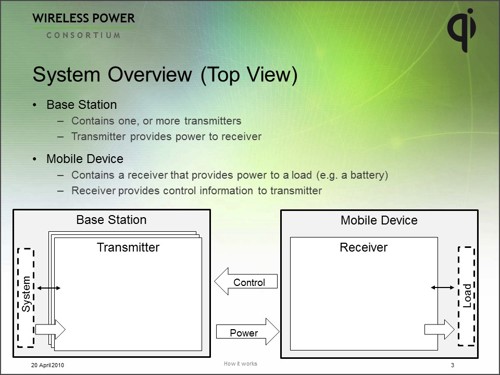
Image source: Wireless Power Consortium
A wireless charging system consists of two primary components: a transmitter coil in the charging pad and a receiver coil embedded in the device. The transmitter drives alternating current through its coil at frequencies between 110 kHz and 360 kHz for the Qi standard, generating an oscillating magnetic field. When the receiver coil enters this field, the changing magnetic flux induces an alternating voltage, which is then rectified to DC and used to charge the battery.
The efficiency of this power transfer depends critically on the coupling coefficient $k$, which measures how much of the magnetic field generated by the transmitter actually passes through the receiver coil:
$$k = \frac{M}{\sqrt{L_1 L_2}}$$Here, $M$ is the mutual inductance between the coils, and $L_1$ and $L_2$ are the self-inductances of the transmitter and receiver coils respectively. A coupling coefficient of 1.0 would mean perfect magnetic coupling—all field lines from one coil pass through the other. In practice, Qi systems achieve coupling coefficients between 0.2 and 0.7, meaning 20% to 70% of the magnetic flux is captured.
Why Wireless Charging Is Less Efficient
Walk into any discussion about wireless charging, and someone will inevitably complain that it’s slower and wastes energy compared to plugging in a cable. They’re not wrong. Wired charging typically operates at 90-95% efficiency, while wireless charging ranges from 60% to 80% under ideal conditions. Several factors contribute to these losses.
The air gap problem. Unlike a conventional transformer where coils are wound around a shared iron core that guides magnetic flux, wireless charging coils are separated by an air gap of 3-10 millimeters. Air has much lower magnetic permeability than iron, causing the magnetic field to spread and weaken significantly before reaching the receiver coil.
Coil resistance. The copper wire in both coils has inherent electrical resistance. As current flows through these coils, power is dissipated as heat according to $P = I^2 R$. This loss occurs on both transmitter and receiver sides.
Eddy current losses. The rapidly alternating magnetic field induces circulating currents in any nearby conductive materials—not just the receiver coil. These eddy currents dissipate energy as heat in the device chassis, circuit board traces, and even in the ferrite shielding layers designed to contain the field.
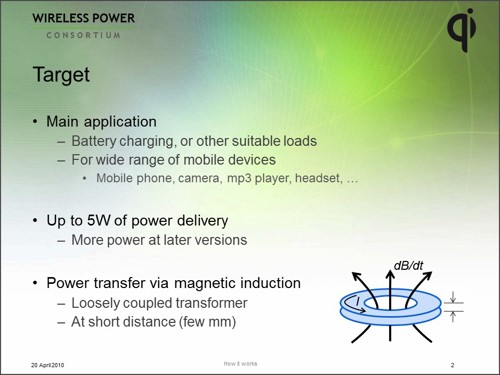
Image source: Wireless Power Consortium
Rectification and regulation. The induced AC voltage must be converted to DC and regulated to the appropriate charging voltage. Each conversion stage introduces losses—typically 5-10% per stage. Modern receivers achieve about 90% efficiency in the rectification stage, but this still represents a significant power loss.
Alignment sensitivity. When the receiver coil is misaligned with the transmitter coil, the coupling coefficient drops dramatically. A study by the IEEE found that misalignment of just 5 millimeters can reduce efficiency by 20-30%. This is why proper placement matters so much on charging pads.
The Qi Standard: Engineering Compromise
The Qi (pronounced “chee”) standard, developed by the Wireless Power Consortium, represents an engineering compromise that prioritized simplicity and safety over maximum efficiency. First introduced in 2008, Qi operates at relatively low frequencies (110-205 kHz for basic power profile) to minimize electromagnetic interference and ease regulatory approval.
The standard defines several power profiles:
| Profile | Maximum Power | Typical Use |
|---|---|---|
| BPP (Baseline Power Profile) | 5W | Basic smartphones |
| EPP (Extended Power Profile) | 15W | Fast charging |
| MPP (Magnetic Power Profile) | 15-25W | Qi2 with magnets |
Qi uses in-band communication—the same coils that transfer power also carry data signals. The receiver modulates its load impedance to send packets back to the transmitter, reporting received power, battery status, and error conditions. This communication enables the transmitter to adjust output power dynamically and shut down when charging completes.
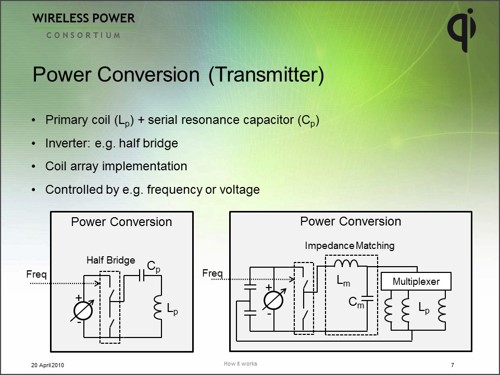
Image source: Wireless Power Consortium
Resonant Coupling: The MIT Breakthrough
In 2007, MIT professor Marin Soljačić and his team demonstrated wireless power transfer over distances of two meters with 40% efficiency—a feat that made headlines worldwide. Their approach used resonant inductive coupling, a technique that Tesla had explored but never fully developed.
The key insight was that when two coils are tuned to the same resonant frequency, energy transfer between them becomes far more efficient, even at greater distances. The quality factor $Q$ of each coil determines how sharply tuned it is:
$$Q = \frac{\omega L}{R}$$Where $\omega$ is the angular frequency, $L$ is inductance, and $R$ is resistance. Higher $Q$ values mean lower energy losses per oscillation cycle and tighter frequency selectivity.
When both transmitter and receiver coils have high Q factors and are tuned to the same frequency, they form a coupled resonator system. Energy oscillates between the magnetic field and the electrical current in each coil, transferring between them much like two tuning forks of the same frequency will resonate together when one is struck.
The AirFuel Alliance standard uses resonant technology operating at 6.78 MHz—much higher than Qi’s 110-205 kHz. This higher frequency, combined with resonant tuning, allows for greater spatial freedom: devices can charge at distances up to 50 mm and with more positional tolerance. However, the standard has seen limited adoption compared to Qi, partly because it requires more complex circuitry and faces greater regulatory scrutiny at higher frequencies.
Qi2 and the Magnetic Alignment Revolution
In 2023, the Wireless Power Consortium adopted Apple’s MagSafe technology as part of the Qi2 standard. The Magnetic Power Profile (MPP) uses a ring of magnets to ensure perfect alignment between transmitter and receiver coils.
The impact on efficiency is significant. When coils are perfectly aligned, the coupling coefficient can reach 0.7 or higher—approaching the theoretical maximum for air-core designs. This translates to faster charging (up to 25W for Qi2) and less wasted energy converted to heat.
The magnetic ring serves a secondary purpose: it enables a new class of accessories that attach magnetically to the back of the phone. Wallets, stands, and battery packs can now snap into place precisely, knowing the charging coil will be correctly positioned.
Foreign Object Detection: Safety’s Hidden Complexity
Drop a paperclip on a wireless charging pad, and something interesting happens: the clip gets hot—potentially dangerously hot. The alternating magnetic field induces eddy currents in any conductive object, and small metal objects have low thermal mass, causing rapid temperature rise.
Qi-certified chargers must implement Foreign Object Detection (FOD) to prevent this hazard. The system operates in two phases:
Pre-power FOD: Before initiating power transfer, the transmitter measures the quality factor (Q) of its coil circuit. A foreign metal object alters the effective Q factor by introducing additional losses. If the measured Q falls below a threshold, the charger refuses to start.
In-power FOD: During charging, the transmitter monitors the difference between power sent and power received. The receiver reports how much power it’s actually receiving; any significant discrepancy indicates energy is being dissipated elsewhere—likely in a foreign object. When this happens, the transmitter shuts down.
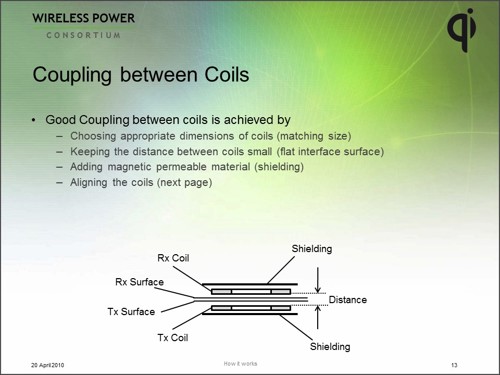
Image source: Wireless Power Consortium
The Efficiency Trade-off: Convenience vs. Energy
A 2019 study by the International Energy Agency’s 4E initiative found that wireless chargers were 67% to 80% as efficient as wired chargers. Under real-world conditions—with imperfect alignment, multiple devices, and varying temperatures—efficiency often falls to the lower end of that range.
Consider what this means for energy consumption. Charging a smartphone battery with 15Wh capacity using a wired charger might require 16-17Wh from the wall outlet. The same charge wirelessly could require 19-25Wh. Spread across billions of devices charged daily, the cumulative energy waste becomes substantial.
Yet the convenience factor is real. No fumbling with cables, no worn-out charging ports, no compatibility concerns between devices. For many users, the trade-off is worth it. The challenge for engineers is closing the efficiency gap through better coil designs, smarter alignment systems, and more efficient power electronics.
What Tesla Got Wrong and Got Right
Tesla’s original vision for wireless power transmission was fundamentally different from modern inductive charging. He proposed using the Earth itself as a conductor, injecting electrical energy at one point and extracting it anywhere else. His Wardenclyffe Tower on Long Island was designed to demonstrate this concept.
The physics, as we now understand it, doesn’t support Tesla’s approach for practical power distribution. The Earth’s conductivity is too low, the required voltages too high, and the interference with radio communications too severe. Tesla was attempting something closer to extremely low frequency radio transmission than inductive coupling.
What Tesla did get right was the principle of resonance. His Colorado Springs experiments demonstrated that tuned circuits could transfer energy efficiently at a distance—though on a scale far smaller than he envisioned. The MIT Witricity breakthrough of 2007 was essentially a sophisticated implementation of principles Tesla had explored a century earlier.
The Future: Spatial Freedom and Higher Power
Current wireless charging technology remains constrained by the need for close proximity and approximate alignment. The next generation aims for true spatial freedom—the ability to charge devices anywhere within a room.
Several approaches are being developed:
Multi-coil arrays: Charging pads with overlapping coil patterns can track a device’s position and activate only the coils needed for optimal coupling. Some systems use this to charge multiple devices simultaneously.
Beamforming magnetic fields: Research groups are exploring phased arrays of coils that can steer magnetic fields toward specific devices, increasing effective range and efficiency.
Millimeter-wave power transfer: For very low-power devices, radio frequency energy can be beamed directly to receivers. This approach trades efficiency for range, suitable for sensors and IoT devices but not smartphones.
The convenience of placing a phone anywhere on a desk and having it charge remains a solved problem only in the laboratory. But the trajectory is clear: each generation of wireless charging technology closes the gap between the convenience Tesla imagined and the physics that constrains what’s actually possible.
References
-
Wireless Power Consortium. “How Qi Works.” https://www.wirelesspowerconsortium.com/knowledge-base/magnetic-induction/how-qi-works/
-
Kurs, A. et al. (2007). “Wireless Power Transfer via Strongly Coupled Magnetic Resonances.” Science, 317(5834), 83-86. https://pubmed.ncbi.nlm.nih.gov/17556549/
-
MIT News. (2014). “A world of wireless power.” https://news.mit.edu/2014/world-wireless-power-witricity-1028
-
NXP Semiconductors. “Coils Used for Wireless Charging - Application Note AN4866.” https://www.nxp.com/docs/en/application-note/AN4866.pdf
-
IEA 4E. (2019). “Global Forecast of Energy Use for Wireless Charging.” https://www.iea-4e.org/wp-content/uploads/publications/2019/07/Topic4_-_Energy_Use_for_Wireless_Charging_FINAL.pdf
-
DigiKey. (2016). “Inductive Versus Resonant Wireless Charging.” https://www.digikey.com/en/articles/inductive-versus-resonant-wireless-charging
-
AirFuel Alliance. “How Wireless Charging Works.” https://airfuel.org/how-wireless-charging-works/
-
Granite River Labs. (2023). “Evolution of Qi Wireless Charging Standard & What’s New With Qi2.” https://www.graniteriverlabs.com/en-us/technical-blog/qi2-wireless-charging-standards-evolution
-
IEEE. “Mutual inductance calculation for coils with misalignment in wireless power transfer systems.” https://digital-library.theiet.org/doi/full/10.1049/joe.2018.8670
-
iFixit. (2024). “Wireless Charging: Trading Efficiency for Convenience.” https://www.ifixit.com/News/94409/wireless-charging-trading-efficiency-for-convenience
-
Tesla Science Center. “Tesla’s Wireless Power.” https://teslasciencecenter.org/teslas-wireless-power/
-
Wikipedia. “Inductive charging.” https://en.wikipedia.org/wiki/Inductive_charging
-
Wikipedia. “Qi (standard).” https://en.wikipedia.org/wiki/Qi_(standard)
-
Wikipedia. “Resonant inductive coupling.” https://en.wikipedia.org/wiki/Resonant_inductive_coupling