In 1935, Albert Einstein, Boris Podolsky, and Nathan Rosen published a paper that would spark one of the most profound debates in the history of physics. They argued that quantum mechanics must be incomplete because it allowed for what Einstein would later famously call “spooky action at a distance”—the phenomenon now known as quantum entanglement. Nearly a century later, entanglement remains one of the most misunderstood concepts in physics, particularly regarding whether it can be exploited for faster-than-light communication.
The short answer is no. But understanding why requires a journey through some of the most subtle and fascinating aspects of quantum mechanics.
What Quantum Entanglement Actually Is
When two particles become entangled, they share a single quantum state. This means that the properties of the two particles are correlated in a way that cannot be described classically. If you measure one particle, you instantly know something about the other—regardless of the distance between them.
Consider a pair of entangled photons with correlated polarizations. Before measurement, neither photon has a definite polarization. They exist in a superposition of possibilities. When you measure one photon and find it polarized vertically, you instantly know that its entangled partner, even if it’s on the other side of the galaxy, will be polarized horizontally (or vertically, depending on how the entanglement was prepared).

Image source: Nobel Prize
This instantaneous correlation seems to suggest that information travels faster than light. After all, you learn something about a distant particle the moment you measure its partner. But here’s where the crucial distinction lies: correlation is not communication.
The Measurement Problem: You Cannot Force an Outcome
To understand why entanglement cannot transmit information, consider what actually happens during a measurement.
Imagine Alice and Bob share an entangled pair of particles. Alice wants to send Bob a message. She thinks: “If I want to send a 1, I’ll measure my particle and force it into state 1. If I want to send a 0, I’ll measure it and force it into state 0.”
The problem? Quantum measurements don’t work that way.
When Alice measures her particle, she cannot choose the outcome. The result is fundamentally random. If the entangled state is an equal superposition, Alice has a 50% chance of getting outcome 0 and a 50% chance of getting outcome 1. She has no control over which result appears.
From Bob’s perspective, when he measures his particle, he also gets a random result. The only way he would know that Alice measured her particle is if he could somehow detect that his results are no longer random—which is impossible. Each individual measurement outcome is completely random. The correlation only becomes apparent when Alice and Bob compare their results after the fact.

Image source: Wikipedia
This randomness is not a technological limitation. It’s a fundamental feature of quantum mechanics, codified in what’s known as the Born rule: the probability of obtaining any particular measurement outcome is given by the square of the amplitude of the corresponding wave function component. This is intrinsic to nature, not something that can be engineered away.
The No-Communication Theorem
The impossibility of using entanglement for faster-than-light communication has been mathematically proven in what physicists call the no-communication theorem.
The theorem shows that when two parties share entangled particles, any quantum operation performed by one party cannot change the statistics of measurements performed by the other party. In other words, Alice’s actions on her particle have zero effect on the probability distribution of Bob’s measurement outcomes.
This might seem paradoxical given that entanglement creates correlations. But here’s the key insight: entanglement creates correlations between measurement outcomes, not between the measurement operations themselves. The correlation exists in the joint state of the two particles, but neither particle carries any information about what happens to the other.
Mathematically, if Alice and Bob share an entangled state $|\psi\rangle_{AB}$, and Alice performs any operation on her subsystem, Bob’s reduced density matrix $\rho_B = \text{Tr}_A(|\psi\rangle\langle\psi|)$ remains unchanged. Bob’s measurement statistics depend only on $\rho_B$, which is unaffected by anything Alice does locally.
Why “Changing Measurement Basis” Doesn’t Work Either
A more sophisticated attempt to exploit entanglement involves using different measurement bases. The idea goes like this:
- To send a 1, Alice measures in the computational basis (asking “are you 0 or 1?”)
- To send a 0, Alice measures in a different basis (asking “are you in state + or -?”)
The hope is that by choosing different measurement bases, Alice could influence the statistics of Bob’s measurements.
This also fails, for a subtle reason related to another fundamental result: the no-cloning theorem.
To detect which basis Alice used, Bob would need to determine the probability distribution of his particle’s state. But you cannot determine a probability distribution from a single measurement. Bob would need to make many copies of his quantum state and measure them all.
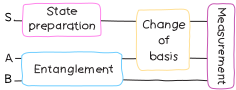
Image source: PennyLane
But the no-cloning theorem proves that it’s impossible to create perfect copies of an unknown quantum state. Formally, there is no unitary operator $U$ such that for all states $|\phi\rangle$ and $|\psi\rangle$:
$$U(|\phi\rangle_A|e\rangle_B) = |\phi\rangle_A|\phi\rangle_B$$The proof is straightforward but profound. If you could clone quantum states, you could indeed use entanglement for superluminal communication. But quantum mechanics forbids this in a way that’s internally consistent and preserves causality.
Quantum Teleportation Requires Classical Channels
The term “quantum teleportation” often leads to confusion. It sounds like something out of science fiction—instantly transporting matter across space. But quantum teleportation is actually a protocol for transferring quantum information, and it explicitly requires classical communication that travels at or below the speed of light.
In the teleportation protocol, Alice and Bob share an entangled pair. Alice wants to send an unknown quantum state to Bob. She performs a Bell-state measurement on her particle and the particle she wants to teleport, then sends the measurement result to Bob via a classical channel (a phone call, radio signal, or any conventional communication method).
Only after receiving Alice’s classical message (which travels at light speed at most) can Bob reconstruct the teleported state on his end. Without that classical information, Bob has no idea which quantum operation to apply to recover the original state.
This is not a limitation of current technology—it’s a fundamental requirement. The quantum state being teleported is destroyed at Alice’s location and cannot be reconstructed at Bob’s location without the classical information.
The Bell Tests: Proving Quantum Mechanics Is Weird, But Not That Weird
In 2022, Alain Aspect, John Clauser, and Anton Zeilinger received the Nobel Prize in Physics for their experiments demonstrating the violation of Bell inequalities. These experiments proved that quantum mechanics is genuinely nonlocal—there really are correlations that cannot be explained by any local hidden variable theory.

Image source: Nobel Prize
Aspect’s 1982 experiment was particularly significant because it closed the “locality loophole.” By rapidly switching the polarizer settings while the photons were in flight, Aspect ensured that no signal traveling at light speed could coordinate the measurements on the two sides. The correlations persisted, proving that quantum mechanics violates local realism.
But—and this is crucial—these same experiments also confirm the no-communication theorem. The violation of Bell inequalities shows that measurement outcomes are correlated beyond classical limits, but those correlations are only revealed when the measurement results are brought together and compared. Neither observer can tell anything about the other’s measurements from their own results alone.
Why Faster-Than-Light Communication Would Break Reality
If faster-than-light communication were possible, it would violate causality—the principle that cause must precede effect. According to special relativity, observers moving at different velocities disagree about the temporal order of spacelike-separated events. If Alice could send a signal to Bob faster than light, there would exist reference frames in which Bob receives the signal before Alice sends it.
This would create paradoxes: Bob could send a return signal telling Alice not to send the original message, which would mean Bob never received a message to respond to. The universe would become logically inconsistent.
Quantum mechanics, with its no-communication theorem, neatly avoids this disaster. The nonlocality of entanglement is real—the universe is genuinely holistic in ways that defy classical intuition—but this nonlocality cannot be harnessed to transmit information. Nature, it seems, is weird enough to be interesting, but not so weird as to be impossible.
What Entanglement Is Actually Good For
Despite the impossibility of superluminal communication, entanglement is far from useless. It enables remarkable technologies:
Quantum Key Distribution (QKD) allows two parties to generate a shared secret key with guaranteed security. Any eavesdropper attempting to intercept the quantum signals will disturb the entanglement, revealing their presence.
Quantum Computing exploits entanglement to perform calculations that would be intractable for classical computers. Entangled qubits can represent and process exponentially more information than their classical counterparts.
Quantum Networks aim to distribute entanglement across long distances, enabling distributed quantum computing and secure communication channels.

Image source: Nobel Prize
These applications don’t require faster-than-light communication. They work precisely because entanglement creates correlations that can be verified after the fact, enabling protocols that are impossible with classical resources alone.
The Deeper Lesson
The fact that quantum entanglement cannot transmit information faster than light is not a bug—it’s a feature. It represents a deep consistency between quantum mechanics and special relativity. The two theories, which might seem incompatible at first glance, actually dovetail beautifully.
Quantum mechanics tells us that the universe is fundamentally probabilistic and that separated systems can remain connected in ways that have no classical analog. Special relativity tells us that no influence can propagate faster than light and that causality must be preserved. The no-communication theorem, along with the no-cloning theorem and the Born rule, ensures that these two profound insights can coexist.
Einstein was right to be troubled by entanglement. It is genuinely strange. But he was also right, in a different way, to trust that the universe would not allow logical paradoxes. The spooky action at a distance is real, but it cannot be weaponized to violate causality. Nature, in its infinite subtlety, has built in safeguards that preserve both quantum holism and relativistic causality.
The dream of instantaneous communication across the cosmos will remain science fiction. But the reality of quantum entanglement—creating instantaneous correlations that span astronomical distances—is, in its own way, even more remarkable.
References
-
Einstein, A., Podolsky, B., & Rosen, N. (1935). “Can Quantum-Mechanical Description of Physical Reality be Considered Complete?” Physical Review, 47(10), 777-780.
-
Bell, J. S. (1964). “On the Einstein Podolsky Rosen Paradox.” Physics Physique Физика, 1(3), 195-200.
-
Aspect, A., Grangier, P., & Roger, G. (1982). “Experimental Realization of Einstein-Podolsky-Rosen-Bohm Gedankenexperiment: A New Violation of Bell’s Inequalities.” Physical Review Letters, 49(2), 91-94.
-
Wootters, W. K., & Zurek, W. H. (1982). “A single quantum cannot be cloned.” Nature, 299(5886), 802-803.
-
Dieks, D. (1982). “Communication by EPR devices.” Physics Letters A, 92(6), 271-272.
-
Nobel Prize Committee. (2022). “The Nobel Prize in Physics 2022 - Popular Science Background.” Royal Swedish Academy of Sciences.
-
Orzel, C. (2016). “The Real Reasons Quantum Entanglement Doesn’t Allow Faster-Than-Light Communication.” Forbes.
-
Preskill, J. (1998). “Quantum Computing: Lecture Notes.” California Institute of Technology.
-
Nielsen, M. A., & Chuang, I. L. (2010). Quantum Computation and Quantum Information. Cambridge University Press.
-
Bengtsson, I., & Życzkowski, K. (2017). Geometry of Quantum States: An Introduction to Quantum Entanglement. Cambridge University Press.