A smartphone bought in 2020 holds 100% of its original capacity. By 2023, that same phone struggles to hold 85%. The owner might blame charging habits, heat, or cheap manufacturing. But the real culprit is fundamental chemistry: every lithium-ion battery contains a limited supply of lithium atoms, and every charge-discharge cycle permanently consumes some of them.
In 2019, M. Stanley Whittingham, John Goodenough, and Akira Yoshino received the Nobel Prize in Chemistry for developing the lithium-ion battery. Their work, spanning from the 1970s through the 1990s, created the energy storage technology that powers modern life. Yet the same electrochemistry that makes these batteries revolutionary also guarantees their eventual death.
Understanding why batteries degrade requires diving into processes that occur at the nanometer scale: the formation of protective layers that grow too thick, metal ions that dissolve from one electrode and poison another, and lithium atoms that deposit in the wrong places during fast charging. These mechanisms don’t just reduce capacity—they transform the battery’s internal structure in ways that cannot be reversed.
The Architecture of Energy Storage
A lithium-ion battery operates through a deceptively simple principle. During charging, lithium ions migrate from the cathode (positive electrode) through an electrolyte to intercalate—insert themselves—into the anode (negative electrode), typically made of graphite. Electrons flow through an external circuit to balance the charge. During discharge, the process reverses: lithium ions flow back to the cathode while electrons power the device.
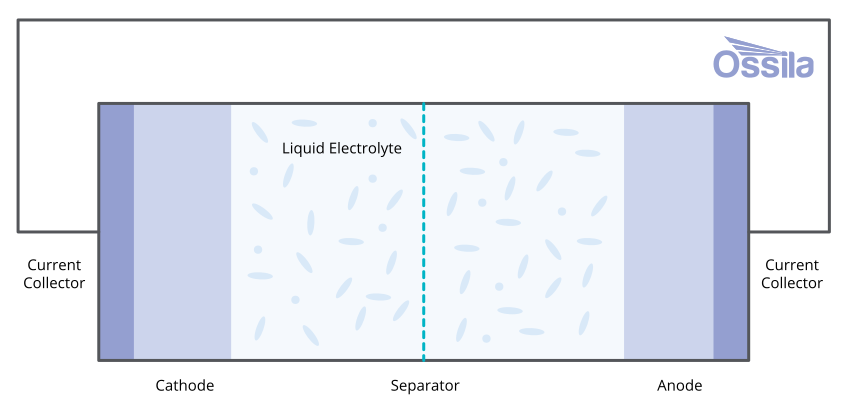
Image source: Ossila - Lithium-Ion Battery Diagram, Components & Principles
The key components include:
- Cathode: Lithium metal oxide (NMC, LFP, NCA, or LCO) that supplies lithium ions
- Anode: Typically graphite powder that hosts lithium ions during charging
- Electrolyte: A solution of lithium salt (usually LiPF₆) in organic solvents
- Separator: A porous polymer membrane that prevents electrical contact between electrodes
This architecture stores energy through lithium’s ability to reversibly intercalate into electrode materials. But every component is chemically active, and over time, they react with each other in ways that permanently consume the battery’s resources.
The SEI Layer: Essential Protection That Becomes a Liability
The moment a lithium-ion battery is first charged, a race begins. The electrolyte touches the anode surface, which has an electrochemical potential far below the stability window of organic solvents. The electrolyte should spontaneously decompose—but instead, decomposition products form a protective layer called the solid electrolyte interphase (SEI).
Formation and Function
The SEI forms through reductive decomposition of electrolyte components at the anode surface. Ethylene carbonate, a common solvent, undergoes both one-electron and two-electron reduction processes to produce lithium carbonate (Li₂CO₃), lithium alkyl carbonates (ROCO₂Li), and other compounds. These products precipitate onto the anode, creating a heterogeneous layer typically 10-50 nanometers thick.

Image source: Ossila - An Introduction to the Solid Electrolyte Interphase (SEI) Layer
A properly formed SEI serves two critical functions. It is ionically conductive, allowing lithium ions to pass through to the anode. Simultaneously, it is electronically insulating, preventing further electron transfer that would continue decomposing the electrolyte. This passivation is what makes rechargeable lithium-ion batteries possible—without it, the electrolyte would be consumed within a few cycles.
The Growth Problem
The SEI is never perfectly stable. Every charge-discharge cycle causes the graphite anode to expand and contract by approximately 10% in volume as lithium intercalates and de-intercalates. This mechanical stress cracks the SEI layer, exposing fresh anode surface to the electrolyte. The exposed surface triggers new SEI formation, consuming additional lithium and electrolyte.
A study published in Nature Communications in 2022 quantified this process: SEI growth is one of the two dominant degradation mechanisms in commercial lithium-ion cells, accounting for roughly 20-40% of capacity loss over the battery’s lifetime. The SEI doesn’t just grow—it also increases the battery’s internal resistance, making it harder for lithium ions to reach the anode.
Why It Cannot Be Reversed
The SEI is not a passive coating—it’s a permanent chemical transformation. The electrolyte molecules that formed it have been chemically altered; they cannot reassemble into their original state. The lithium atoms incorporated into the SEI are no longer available to store charge. This represents a fundamental loss of lithium inventory (LLI), one of the three primary degradation modes alongside loss of active material (LAM) and increased resistance.
Lithium Plating: When Ions Choose the Wrong Path
Fast charging a smartphone from 0% to 100% in 20 minutes sounds convenient. The problem: lithium ions may not intercalate into the graphite anode fast enough to keep up. When the anode’s potential drops below 0V versus Li/Li⁺, lithium ions begin depositing as metallic lithium on the surface instead of intercalating into the graphite structure.
The Mechanism
During normal charging, lithium ions diffuse through the electrolyte to the anode surface, then intercalate into the graphite’s layered structure. This intercalation has a kinetic limit—there’s a maximum rate at which lithium can enter the graphite. When charging current exceeds this rate, lithium ions accumulate at the anode surface and undergo direct reduction:
$$Li^+ + e^- \rightarrow Li^0$$Metallic lithium forms on the anode surface as a grayish deposit. In mild cases, this lithium can be re-oxidized during subsequent discharge. But often, the metallic lithium reacts with the electrolyte to form additional SEI, or becomes electrically isolated—“dead lithium” that can never participate in charge storage again.
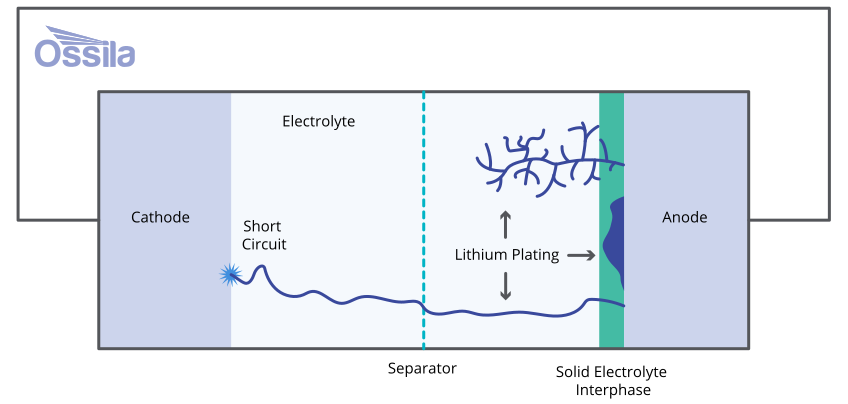
Image source: Ossila - What is Lithium Plating?
Conditions That Promote Plating
Three conditions dramatically increase lithium plating risk:
Low Temperature: At 0°C, lithium-ion diffusion into graphite is approximately 10 times slower than at 25°C. The same charging current that would be safe at room temperature becomes dangerous in cold conditions. Research published in Joule showed that charging at 0°C with even moderate C-rates (charging speed relative to capacity) can result in detectable lithium plating within just a few cycles.
High State of Charge: When the anode is already nearly full of lithium ions, there are fewer available sites for intercalation. Additional lithium arriving at the surface has nowhere to go and plates instead. This is why fast charging is most dangerous at high states of charge.
High Current Density: The higher the charging current, the more lithium ions arrive at the anode surface per unit time. When the influx exceeds the intercalation rate, plating becomes inevitable. The critical current threshold depends on temperature, state of charge, and anode design, but the relationship is clear: faster charging means more plating.
Detection and Consequences
Lithium plating is difficult to detect in real-time because it occurs inside a sealed cell. However, researchers have developed methods using anode potential monitoring. When the anode potential drops below 0V versus Li/Li⁺, plating is occurring. The “plating energy”—the integral of anode potential below zero during charging—provides a quantitative measure of plating severity.
The consequences extend beyond capacity loss. Metallic lithium can grow as dendrites—needle-like structures that extend from the anode surface. If these dendrites penetrate the separator and reach the cathode, they create an internal short circuit. The result can be thermal runaway: rapid heating, gas generation, and in extreme cases, fire or explosion.
Cathode Degradation: The Other Side of the Equation
While much attention focuses on the anode, the cathode undergoes its own degradation processes. These mechanisms are chemistry-dependent, with different cathode materials showing distinct failure modes.
Transition Metal Dissolution
NMC (lithium nickel manganese cobalt oxide) cathodes, widely used in electric vehicles, suffer from transition metal dissolution. During cycling, especially at high states of charge and elevated temperatures, manganese, cobalt, and nickel ions can dissolve from the cathode structure into the electrolyte.
A 2021 study in ACS Applied Materials & Interfaces traced the pathway of these dissolved metals. They migrate through the electrolyte to the anode, where they deposit on the graphite surface. These metal deposits catalyze additional SEI formation and increase interfacial resistance. The cathode loses active material; the anode gains contamination.
The dissolution is particularly severe for manganese. NMC cathodes with higher manganese content show faster degradation in high-temperature applications—a trade-off between cost (manganese is cheaper than cobalt) and longevity.
Structural Degradation
Layered cathode materials like NMC undergo structural changes during cycling. When lithium is extracted during charging, the material expands. When lithium returns during discharge, it contracts. This “breathing” motion causes mechanical stress that can crack cathode particles, expose fresh surfaces to electrolyte, and create electrically isolated regions that no longer participate in charge storage.
At high states of charge (above approximately 4.2V for NMC), another problem emerges: oxygen release. The cathode structure becomes unstable and releases oxygen atoms, which react with the electrolyte in exothermic reactions. This is one of the triggers for thermal runaway and a reason why overcharging is so dangerous.
LFP Stability and Trade-offs
Lithium iron phosphate (LFP) cathodes avoid many of these problems. The strong phosphorus-oxygen bonds in the olivine structure resist oxygen release, and iron dissolution is minimal compared to manganese. LFP batteries consistently show longer cycle life—often 3,000-6,000 cycles compared to 1,000-2,000 for NMC under equivalent conditions.
But LFP has trade-offs. Its energy density is approximately 30% lower than NMC, meaning larger and heavier batteries for the same range. The choice between LFP and NMC reflects a fundamental tension in battery design: longevity versus energy density.
Calendar Aging: The Clock That Never Stops
A battery degrades even when sitting on a shelf. This calendar aging occurs through chemical reactions that proceed independently of cycling, driven by the thermodynamic instability of the battery’s components.
The Temperature-Accelerated Reaction
Calendar aging follows Arrhenius kinetics—the rate of degradation increases exponentially with temperature. A battery stored at 40°C degrades approximately twice as fast as one stored at 25°C. At 60°C, degradation accelerates by roughly a factor of four to eight.
A comprehensive study published in the Journal of The Electrochemical Society examined calendar aging across 16 different states of charge. The results showed that both temperature and state of charge matter. Batteries stored at 100% state of charge and 45°C lost over 20% capacity in one year. The same batteries stored at 20% state of charge and 25°C lost less than 5%.
The Mechanism
During storage, the SEI continues to grow slowly through parasitic reactions between the electrolyte and anode. The electrolyte oxidizes at the cathode surface, forming a cathode electrolyte interphase (CEI) analogous to the SEI. These processes consume both lithium and electrolyte even without any external current flow.
The mechanism connects directly to thermodynamics. A fully charged battery has its anode at maximum lithium concentration and maximum chemical potential. This high potential drives continuous, slow reduction reactions at the anode. A battery stored at lower states of charge has less driving force for these reactions.
Thermal Runaway: When Degradation Becomes Dangerous
Most degradation simply reduces capacity. But certain degradation pathways can lead to thermal runaway—a self-accelerating process where heat generation exceeds heat dissipation, causing temperature to spiral upward.
The Cascade of Reactions
Thermal runaway proceeds through a predictable sequence of exothermic reactions:
| Temperature | Event | Consequence |
|---|---|---|
| ~80°C | SEI decomposition | Exposes anode to electrolyte |
| ~100°C | Electrolyte decomposition | Releases flammable gases |
| ~130°C | Separator melting | Electrodes contact, short circuit |
| ~150°C | Cathode decomposition | Releases oxygen, intensifies fire |

Image source: Ossila - What is Thermal Runaway in Batteries?
A 2018 study in the Journal of The Electrochemical Society found that the energy released during thermal runaway increases with battery age. After 15 charging cycles, a battery released approximately 1 kJ in exothermic reactions. After 45 cycles, this tripled to over 3 kJ. Aging increases the amount of reactive material available, making older batteries more dangerous when they fail.
The Role of Degradation
Degradation creates conditions that favor thermal runaway. Lithium plating deposits reactive metallic lithium on the anode surface. SEI cracking exposes fresh anode material. Cathode degradation creates unstable surface phases. Separator aging weakens the mechanical barrier between electrodes.
The UK Fire Service reported 921 lithium-ion battery fires in 2023—a 46% increase from the previous year. While most fires result from damage, overcharging, or manufacturing defects, aged batteries have narrower safety margins and can fail from stresses that would be harmless to new cells.
What Actually Helps: Evidence-Based Interventions
Given these degradation mechanisms, what practices actually extend battery life? The research points to several clear conclusions.
Temperature Management
Temperature is the single most important controllable factor. Batteries should operate within their comfort zone (typically 15-35°C for most chemistries) and avoid prolonged exposure to extreme heat. A study by Sandia National Laboratory, integrating 7 million data points from accelerated aging tests, found that temperature control had a larger effect on cycle life than any other variable.
For electric vehicles, this means pre-conditioning the battery before fast charging in cold weather. For consumer electronics, it means avoiding charging under pillows or in hot cars. The battery’s optimal temperature window is narrower than most users realize.
State of Charge Management
Keeping batteries at moderate states of charge (20-80%) minimizes degradation from two sources. First, it reduces the driving force for calendar aging. Second, it keeps the anode below the high-lithium-concentration region where plating becomes likely during charging.
However, the benefit varies by chemistry. LFP batteries are relatively insensitive to state of charge during storage—they can sit at 100% with minimal penalty. NMC and NCA batteries benefit more from mid-range storage. This is why some electric vehicle manufacturers recommend daily charging to 80% for NMC batteries but 100% for LFP.
Charging Rate Discipline
Fast charging is convenient but chemically stressful. The relationship between charging rate and degradation is non-linear—doubling the charging rate can more than double the degradation rate. A 2024 analysis of real-world EV data by Geotab found that frequent DC fast charging accelerated battery degradation compared to primarily Level 2 charging.
The practical implication: use fast charging when needed, but don’t make it the default. For devices that support it, slower charging (such as overnight at 1A for a smartphone) produces less degradation than rapid charging.
Depth of Discharge Considerations
Shallow cycling—using only a portion of the battery’s capacity—reduces mechanical stress on electrodes. Data from Battery University testing shows that a lithium-ion cell cycled from 100% to 0% might achieve 300-600 cycles before reaching 80% capacity. The same cell cycled from 75% to 25% could achieve 1,000-3,000 cycles.
The trade-off is usability. Most users won’t artificially limit their battery’s useful range. But understanding the relationship helps explain why applications with controlled charge windows (like grid storage or fleet vehicles) can achieve much longer battery life than consumer devices.
The Future: Solid-State and Beyond
Current research addresses these fundamental limitations through several approaches. Solid-state batteries replace the liquid electrolyte with a solid material, potentially eliminating dendrite penetration and reducing flammability. Silicon anodes offer 10× the capacity of graphite but suffer from 300% volume expansion during cycling. New electrolyte additives can form more flexible SEI layers that accommodate volume changes without cracking.
Each approach trades one set of challenges for another. Solid-state batteries face manufacturing complexity and interface resistance. Silicon anodes require nanostructuring and binders that can accommodate extreme volume changes. No technology eliminates degradation—they only change its rate and mechanism.
Accepting the Inevitable
Every lithium-ion battery is a consumable component. The 2019 Nobel Prize recognized a technology that transformed portable electronics and enabled the electric vehicle revolution. It also created the first mass-market energy storage device with a predictable, irreversible death.
The chemistry that stores energy—the intercalation of lithium into electrode materials—also drives the processes that consume it. SEI growth, lithium plating, transition metal dissolution, and structural degradation are not bugs to be fixed but consequences of the underlying electrochemistry.
Understanding these mechanisms doesn’t eliminate degradation. But it does enable better decisions: choosing LFP when longevity matters, avoiding fast charging at low temperatures, storing devices at moderate states of charge, and recognizing that after 500-1,000 cycles, a battery has simply delivered the energy it was designed to deliver. The degradation is not a failure—it’s the cost of the energy we extracted.
References
-
Whittingham, M. S. (1976). Electrical Energy Storage and Intercalation Chemistry. Science, 192(4244), 1126-1127.
-
Goodenough, J. B., & Park, K. S. (2013). The Li-Ion Rechargeable Battery: A Perspective. Journal of the American Chemical Society, 135(4), 1167-1176.
-
Yoshino, A. (2012). The Birth of the Lithium-Ion Battery. Angewandte Chemie International Edition, 51(24), 5798-5800.
-
Attia, P. M., et al. (2022). Data-Driven Prediction of Battery Cycle Life Before Capacity Degradation. Nature Energy, 7(3), 257-267.
-
Edge, J. S., et al. (2021). Lithium Ion Battery Degradation: What You Need to Know. Physical Chemistry Chemical Physics, 23, 8200-8221.
-
Li, H., et al. (2022). SEI Growth Mechanisms in Lithium-Ion Batteries: A Review. Electrochimica Acta, 426, 140772.
-
Ossila. (2024). Lithium-Ion Battery Diagram, Components & Principles. https://www.ossila.com/pages/lithium-ion-batteries
-
Ossila. (2024). An Introduction to the Solid Electrolyte Interphase (SEI) Layer. https://www.ossila.com/pages/solid-electrolyte-interphase
-
Ossila. (2024). What is Lithium Plating? https://www.ossila.com/pages/lithium-plating
-
Ossila. (2024). What is Thermal Runaway in Batteries? https://www.ossila.com/pages/thermal-runaway
-
Keil, P., & Jossen, A. (2016). Calendar Aging of Lithium-Ion Batteries. Journal of The Electrochemical Society, 163(9), A1872-A1880.
-
Waldmann, T., et al. (2018). Review—Post-Mortem Analysis of Aged Lithium-Ion Batteries: Disassembly Methodology and Physico-Chemical Analysis Techniques. Journal of The Electrochemical Society, 165(16), A3529-A3545.
-
Galushkin, N. E., Yazvinskaya, N. N., & Galushkin, D. N. (2018). Mechanism of Thermal Runaway in Lithium-Ion Cells. Journal of The Electrochemical Society, 165(7), A1303-A1308.
-
Geotab. (2026). EV Battery Health: Key Findings from 22,700 Vehicle Data Analysis. https://www.geotab.com/blog/ev-battery-health/
-
Thunder Said Energy. (2024). Battery Degradation: What Causes Capacity Fade? https://thundersaidenergy.com/downloads/battery-degradation-what-causes-capacity-fade/
-
Battery University. (2023). BU-808: How to Prolong Lithium-based Batteries. http://www.batteryuniversity.com/article/bu-808-how-to-prolong-lithium-based-batteries/
-
Recurrent. (2024). EV Study Reveals Impacts of Fast Charging. https://www.recurrentauto.com/research/impacts-of-fast-charging
-
Zhang, S. S. (2006). A Review on Electrolyte Additives for Lithium-Ion Batteries. Journal of Power Sources, 162(2), 1379-1394.
-
Vetter, J., et al. (2005). Ageing Mechanisms in Lithium-Ion Batteries. Journal of Power Sources, 147(1-2), 269-281.
-
Liu, K., et al. (2018). Electrochemical Reactivity of Lithium Plating. Joule, 2(11), 2296-2306.
-
Richter, K., et al. (2021). Understanding Degradation at the Lithium-Ion Battery Cathode/Electrolyte Interface. ACS Applied Materials & Interfaces, 13(10), 11902-11914.
-
Sinovoltaics. (2024). Stages of The Thermal Runaway Process in Lithium Batteries. https://sinovoltaics.com/energy-storage/batteries/stages-of-the-thermal-runaway-process-in-lithium-batteries/
-
University of Michigan. (2020). Tips for Extending the Lifetime of Lithium-Ion Batteries. https://news.umich.edu/tips-for-extending-the-lifetime-of-lithium-ion-batteries/
-
Xu, J., et al. (2024). A Comprehensive Review on Lithium-Ion Battery Lifetime Prediction from Mechanism to Data-Driven Approaches. Batteries, 11(4), 127.
-
McDowell, M. T., et al. (2013). 25th Anniversary Article: Understanding the Lithium-Ion Battery. Advanced Materials, 25(36), 4976-4986.