In 1903, the Wright brothers achieved the first powered, controlled flight. Within two decades, the mathematics of lift was largely solved. Yet in 2020, Scientific American published an article titled “No One Can Explain Why Planes Stay in the Air.” The paradox is real: engineers can calculate lift with precision, but explaining why it happens has sparked debates lasting over a century.
The controversy centers on two apparently competing explanations. One camp invokes Bernoulli’s principle—faster air on top means lower pressure, creating an upward force. The other camp cites Newton’s third law—the wing pushes air down, so air pushes the wing up. Both are correct. Both are incomplete. And the most widely taught explanation in high school physics is demonstrably false.
The Myth of Equal Transit Time
Open a typical physics textbook from the past fifty years. The explanation for lift often reads like this: an airplane wing is curved on top and flat on the bottom. Air traveling over the top must traverse a longer path. Since the air molecules on top and bottom must meet at the trailing edge simultaneously, the upper flow must move faster. Faster flow means lower pressure (Bernoulli’s principle), creating lift.
This is the “equal transit time” theory. NASA’s Glenn Research Center explicitly labels it “incorrect” on their educational website.
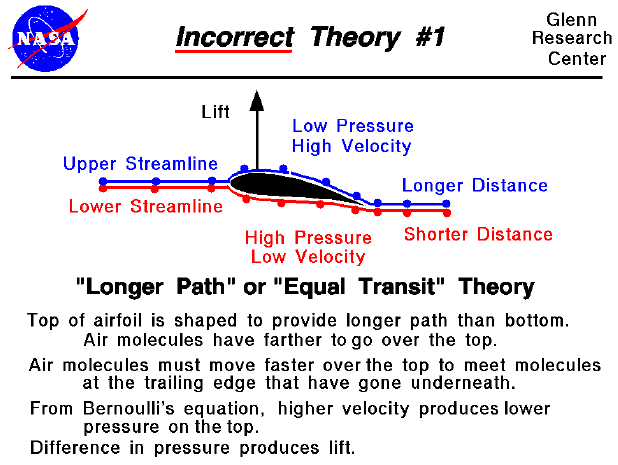
Image source: NASA Glenn Research Center - Incorrect Lift Theory
The theory fails on multiple counts. First, there is no physical principle requiring air molecules to meet at the trailing edge simultaneously. Experiments consistently show that the air traveling over the top arrives at the trailing edge before the air traveling underneath—not at the same time. The actual velocity difference is far greater than the equal-transit assumption predicts.
Second, symmetric airfoils generate lift perfectly well. A NACA 0012 wing—identical curvature on top and bottom—produces substantial lift when angled to the oncoming flow. Paper airplanes with flat, thin wings fly. Balsa wood gliders work perfectly. According to the equal transit theory, these shouldn’t generate any lift at all.
Third, aerobatic aircraft fly upside down. If lift required a curved upper surface and flat lower surface, inverted flight would be impossible—the “longer path” would be on the wrong side. Yet aircraft at airshows routinely perform inverted passes, their wings generating upward lift while upside down.
Pressure Differences: The Bernoulli Perspective
The Bernoulli equation describes a real relationship between velocity and pressure in a flowing fluid. Derived from conservation of energy, it states that along a streamline:
$$P + \frac{1}{2}\rho v^2 + \rho gh = \text{constant}$$Where $P$ is static pressure, $\rho$ is density, $v$ is velocity, and $h$ is height. For horizontal flow at constant altitude, higher velocity correlates with lower pressure.
This relationship is not wrong. Wind tunnel measurements confirm that the pressure above a lifting wing is indeed lower than the pressure below. The error lies in assuming that the path-length difference causes the velocity difference. The causation runs the other way: the pressure field causes the acceleration.
When a wing moves through air, it creates a pressure field extending far above and below its surface. The pressure is lowest not at the surface itself, but in a diffuse region above and behind the wing. Air accelerates from regions of higher pressure toward regions of lower pressure—Newton’s second law applied to fluid particles. The velocity increase is a consequence, not a cause.
Flow Turning: The Newton Perspective
Newton’s third law states that for every action, there is an equal and opposite reaction. Apply this to aerodynamics: if a wing pushes air downward, the air must push the wing upward.
This is precisely what happens. When air flows past a wing at a positive angle of attack, the flow is deflected downward. This downward deflection—called downwash—is visible in wind tunnel smoke visualizations and in the condensation trails behind aircraft wings in humid conditions.
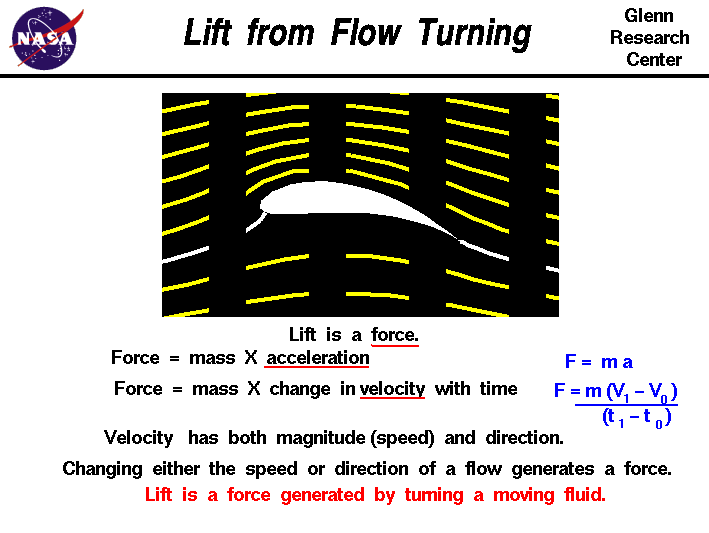
Image source: NASA Glenn Research Center - Lift from Flow Turning
The crucial insight is that the downwash is produced by both wing surfaces, not just the lower one. A common misconception treats the wing like a stone skipping on water—air molecules bouncing off the bottom create lift. This “skip-stone” theory neglects the upper surface entirely. In reality, the upper surface contributes significantly to flow turning, often more than the lower surface.
The momentum change in the air can be quantified. For a wing of span $b$ moving at velocity $V$, generating lift $L$, the vertical momentum flux in the wake equals the lift force:
$$L = \dot{m} \cdot \Delta v_y$$Where $\dot{m}$ is the mass flow rate of air affected and $\Delta v_y$ is the vertical velocity change. This momentum explanation is complete and correct—lift equals the rate of downward momentum imparted to the air.
Circulation: The Mathematical Bridge
In 1902, German mathematician Martin Kutta and Russian physicist Nikolai Joukowski independently discovered a mathematical relationship that unifies the pressure and momentum explanations. The Kutta-Joukowski theorem states:
$$L = \rho V \Gamma$$Where $\Gamma$ (gamma) is the circulation—a measure of rotational flow around the wing.
Circulation might seem abstract, but it has a concrete physical meaning. Imagine a closed loop around an airfoil. Integrate the velocity tangent to this loop at every point. The result is the circulation, measured in square meters per second.
The circulation arises from a fascinating phenomenon: the starting vortex. When a wing begins moving through still air, viscosity prevents the flow from going around the sharp trailing edge and curling back underneath. Instead, the flow separates, forming a vortex that sheds downstream. By conservation of angular momentum, an equal and opposite circulation forms around the wing itself.
The Kutta condition—named after Martin Kutta—specifies that the flow must leave the trailing edge smoothly. This mathematical constraint determines the unique value of circulation for any given airfoil shape and angle of attack.
graph LR
    A[Starting Vortex<br/>Shed Downstream] --> B[Conservation of<br/>Angular Momentum]
    B --> C[Bound Vortex<br/>Around Wing]
    C --> D[Circulation Γ]
    D --> E[Kutta-Joukowski<br/>L = ρVΓ]

    style A fill:#ffcccc
    style C fill:#ccffcc
    style E fill:#ccccff
Streamline Curvature and Pressure
A less-known but powerful explanation comes from the streamline curvature theorem, derived by Leonhard Euler in 1754. When fluid follows a curved path, there must be a pressure gradient perpendicular to the flow:
$$\frac{\partial P}{\partial n} = \frac{\rho v^2}{R}$$Where $n$ is the direction normal to the streamlines and $R$ is the radius of curvature. Higher pressure exists on the outside of the curve; lower pressure on the inside.
This explains why the pressure drops above a wing: the streamlines curve downward, following the wing’s upper surface. The air above is on the “outside” of this curve, so pressure is higher above the streamlines than below them—meaning pressure decreases as you approach the wing surface.
The Complete Picture
A complete explanation of lift requires integrating several concepts:
-
The pressure field: The wing creates a pressure distribution—lower above, higher below. This pressure difference integrated over the wing surface gives the lift force.
-
The velocity field: Air accelerates from high to low pressure regions. The velocity increase above the wing is a consequence of the pressure gradient, consistent with Bernoulli’s principle.
-
The momentum change: The pressure field deflects the flow downward. The downward momentum imparted to the air equals the lift force (Newton’s third law).
-
Circulation: The flow pattern includes a circulatory component, quantifiable by the Kutta-Joukowski theorem. The circulation is determined by the Kutta condition at the trailing edge.
-
Viscosity: While ideal inviscid theory predicts lift remarkably well, viscosity plays a crucial role in establishing the circulation. Without viscosity, there would be no starting vortex, no circulation, and no lift.
The mistake is not using Bernoulli or Newton—both are correct. The mistake is treating them as alternative explanations rather than complementary descriptions of the same phenomenon. Pressure differences and momentum changes are two sides of one coin.
Why Textbooks Got It Wrong
If engineers understood lift correctly by the 1920s, why did textbooks continue teaching the equal transit time fallacy?
Part of the answer lies in pedagogical simplification. The real explanation requires understanding pressure fields, boundary layers, and circulation—concepts beyond high school physics. The equal transit time story offers a simple narrative: curved top means faster flow means lower pressure means lift. It has the illusion of logic.
Another factor is disciplinary silos. Aerodynamicists working with Navier-Stokes equations and potential flow theory have no need for the oversimplified explanation. They calculate lift correctly. The simplified explanations proliferate in introductory physics texts, written by authors outside the aerodynamics community.
Research published in 2021 by Chiu and others traced the equal transit time fallacy through educational literature, finding it in textbooks from the 1940s onward. A 2020 paper in Education Sciences documented a century of misconceptions in flight education, analyzing 140 articles spanning from the Wright brothers to modern times.
NASA’s explicit correction on their educational website represents a recent push toward accuracy. The agency states plainly: “The most popular incorrect theory of lift arises from a mis-application of Bernoulli’s equation.”
Symmetric Airfoils and Angle of Attack
The equal transit time theory cannot explain symmetric airfoils. Yet symmetric wings are common in aerobatic aircraft, helicopter rotors, and submarine control surfaces. How do they work?
The answer lies in angle of attack—the angle between the wing’s chord line and the oncoming flow. Even a flat plate generates lift when tilted into the wind. The Wright brothers’ early gliders used nearly flat wings.
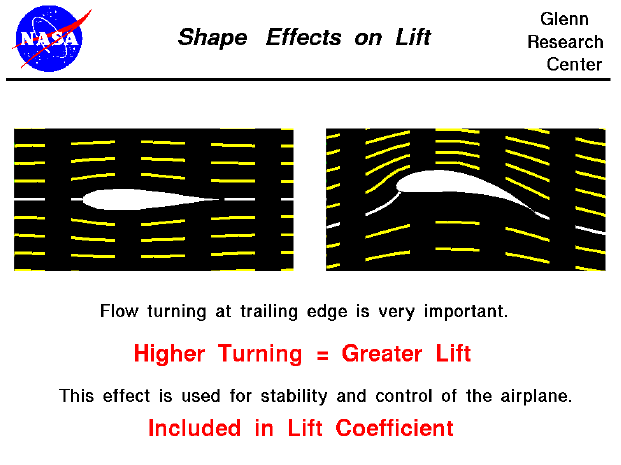
Image source: NASA Glenn Research Center - Effect of Shape on Lift
The figure above shows flow patterns around two airfoils. The symmetric airfoil on the left, at zero angle of attack, produces no net turning—hence no lift. Add a positive angle of attack, and the same symmetric shape generates substantial lift.
Camber—the asymmetry between upper and lower surfaces—merely shifts the zero-lift angle. A cambered airfoil generates lift at zero geometric angle of attack because its trailing edge already points downward. A symmetric airfoil requires a positive angle of attack to achieve the same effect.
Flying Upside Down
If lift depends on flow turning rather than wing shape asymmetry, how does inverted flight work?
When an aircraft flies inverted, the pilot increases the angle of attack. The wing, now with its curved surface facing downward, still deflects air in the appropriate direction. The inverted wing may be less efficient—higher drag for the same lift—but the physics remains identical.
Aerobatic aircraft often use symmetric airfoils precisely because they perform equally well upright and inverted. The cambered airfoils on typical transport aircraft are optimized for right-side-up cruising efficiency, not inverted aerobatics.
The Boundaries of Theory
For all the controversy over qualitative explanations, the quantitative theory is remarkably successful. Computational fluid dynamics simulations predict lift within 1% of wind tunnel measurements. Aircraft design proceeds with confidence.
The remaining disputes are not about whether the equations work—they demonstrably do. The disputes concern how to translate the mathematics into intuitive understanding. Different explanations emphasize different aspects of a unified phenomenon.
What’s clear is that lift is not a mystery. It’s a well-understood consequence of classical physics, involving pressure fields, momentum transfer, and circulation. The mystery is why we continue teaching a simplified story that contradicts experimental evidence.
References
-
NASA Glenn Research Center. “Incorrect Lift Theory.” https://www.grc.nasa.gov/www/k-12/VirtualAero/BottleRocket/airplane/wrong1.html
-
NASA Glenn Research Center. “Bernoulli and Newton.” https://www1.grc.nasa.gov/beginners-guide-to-aeronautics/bernoulli-and-newton/
-
NASA Glenn Research Center. “Lift from Flow Turning.” https://www.grc.nasa.gov/www/k-12/airplane/right2.html
-
NASA Glenn Research Center. “Effect of Shape on Lift.” https://www.grc.nasa.gov/www/k-12/VirtualAero/BottleRocket/airplane/shape.html
-
Anderson, J. D. (2017). Fundamentals of Aerodynamics (6th ed.). McGraw-Hill Education.
-
Babinsky, H. (2003). “How do wings work?” Physics Education, 38(6), 497-503.
-
Weltner, K. & Ingelman-Sundberg, M. (1999). “Physics of Flight—Revisited.” https://user.uni-frankfurt.de/~weltner/Physics%20of%20Flight%20revisited%20internet.pdf
-
Chiu, Y. et al. (2021). “On the Origins and Relevance of the Equal Transit Time Fallacy to Understanding Lift.” arXiv:2110.00690.
-
McLean, D. (2012). Understanding Aerodynamics: Arguing from the Real Physics. Wiley.
-
Wikipedia. “Lift (force).” https://en.wikipedia.org/wiki/Lift_(force)
-
Wikipedia. “Airfoil.” https://en.wikipedia.org/wiki/Airfoil
-
Wikipedia. “Kutta–Joukowski theorem.” https://en.wikipedia.org/wiki/Kutta%E2%80%93Joukowski_theorem
-
Wikipedia. “Kutta condition.” https://en.wikipedia.org/wiki/Kutta_condition
-
Wikipedia. “Starting vortex.” https://en.wikipedia.org/wiki/Starting_vortex
-
West Texas A&M University. “How do airplanes fly upside down if it’s the shape of the wings that make them fly?” https://www.wtamu.edu/~cbaird/sq/2012/12/17/how-do-airplanes-fly-upside-down-if-its-the-shape-of-the-wings-that-make-them-fly/
-
Liu, L. et al. (2015). “The Origin of Lift Revisited: I. A Complete Physical Theory.” ResearchGate. https://www.researchgate.net/publication/299644832_The_Origin_of_Lift_Revisited_I_A_Complete_Physical_Theory